<?xml version="1.0" encoding="utf-8"?><feed xmlns="http://www.w3.org/2005/Atom" ><generator uri="https://jekyllrb.com/" version="3.10.0">Jekyll</generator><link href="https://systemhalted.in/feed/newsletter.xml" rel="self" type="application/atom+xml" /><link href="https://systemhalted.in/" rel="alternate" type="text/html" /><updated>2026-05-20T17:26:44+00:00</updated><id>https://systemhalted.in/feed/newsletter.xml</id><title type="html">The System Halted | Newsletter</title><subtitle>SystemHalted - I am just a DOS error</subtitle><author><name>Palak Mathur</name><email>insanethoughts@live.com</email></author><entry><title type="html">Equality is an idea. Conditioning is an inheritance.</title><link href="https://systemhalted.in/newsletter/2025-12-05-equality-idea-conditioning-inheritance/" rel="alternate" type="text/html" title="Equality is an idea. Conditioning is an inheritance." /><published>2025-12-05T00:00:00+00:00</published><updated>2025-12-05T00:00:00+00:00</updated><id>https://systemhalted.in/newsletter/equality-idea-conditioning-inheritance</id><content type="html" xml:base="https://systemhalted.in/newsletter/2025-12-05-equality-idea-conditioning-inheritance/"><![CDATA[<p>I recently read a reflection on modern feminism that stayed with me.</p>

<p>In our minds we believe in equality. In our conditioning we still expect the old symbols of care.</p>

<blockquote>
  <p>“I want to split the bill, but if he asks to split, why does it pinch?”</p>
</blockquote>

<p>The point was simple and uncomfortable. We are trying to live in both at once. Intellectually we want agency, partnership, shared responsibility. Emotionally we still carry the scripts where a man paying the bill meant care, commitment, seriousness.</p>

<p>The real shift is not about the bill at all. It is the inner realization that being a woman is not weakness and being a man does not automatically make you strong or in control. From that realization you get mutual respect.</p>

<p>A man might still choose to pay, not to dominate but as a gesture of care.</p>

<p>A woman might accept or decline, not from dependency but from a place of security in herself.</p>

<p>The gesture stays. The meaning changes.</p>

<p>Once I saw it that way, I started noticing the same pattern everywhere, especially in organizations going through change.</p>

<p>On the surface you hear all the right words.</p>

<p>Outcome driven.</p>

<p>Customer obsessed.</p>

<p>Empowered teams.</p>

<p>Platform thinking.</p>

<p>Underneath, you can feel older scripts still running quietly.</p>

<p>This is how we have always shipped.</p>

<p>This is how we stay safe.</p>

<p>This is what gets rewarded here, no matter what the posters say.</p>

<p>It is not that one side is progressive and the other backward. People who have been around longer are carrying the culture that helped the company survive its earlier battles. New leaders and new hires are carrying a picture of where the company needs to go next.</p>

<p>Both identities are real.</p>

<p>Both feel at risk when the other gains ground.</p>

<p>That is why process changes often feel so much heavier than they look on a slide. Moving from projects to products is not just a portfolio change. It is a request to rewrite personal stories.</p>

<blockquote>
  <p>“I am valuable because I know this system and can save it at 2 AM”</p>
</blockquote>

<p>has to become</p>

<blockquote>
  <p>“I am valuable because I make this system so reliable that nobody needs saving at 2 AM.”</p>
</blockquote>

<p>Just like splitting the bill is a very technical interpretation of equality, rolling out a new operating model is a very technical interpretation of culture. The deeper work is inner.</p>

<p>Can we honor the experience that got us here and still be honest about what must change?</p>

<p>Can we update ways of working without quietly disrespecting the people who lived the previous version?</p>

<p>Just like being a woman is not weakness and being a man is not automatic strength, having been here a long time is not “stuck” and being new is not automatically “right”.</p>

<p>Equality is an idea. Conditioning is an inheritance.</p>

<p>In the gender conversation we often say:</p>

<blockquote>
  <p>We do not just need equality of opportunity, we need mutual respect.</p>
</blockquote>

<p>In companies the parallel is:</p>

<blockquote>
  <p>We do not just need new results, we need a shared sense of dignity while we change how we get them.</p>
</blockquote>

<p>Trendy language, whether it is around feminism, leadership or culture, will always shed by itself if it stays only on the sleeve. What remains is the substance – the slow work of people seeing each other not as threats from another era, but as partners in a transition that is bigger than any one role.</p>

<p>Whether we are talking about gender roles or organizations, the outer transition is policies and processes. The inner transition is identity and respect.</p>

<p>In healthy transitions, the rituals at work might still look the same on the surface – standups, reviews, launches – but the meaning changes.</p>

<p>From control to trust.</p>

<p>From heroics to reliability.</p>

<p>From “prove your worth” to “design systems where everyone can do their best work”.</p>

<p>We only really move forward when both update together.</p>

<p>Real change happens when those two finally stop fighting each other and start moving in the same direction.</p>

<p>This is the challenge that leaders need to accept and solve.</p>]]></content><author><name>Palak Mathur</name><email>insanethoughts@live.com</email></author><category term="[&quot;Newsletter&quot;]" /><category term="newsletter" /><category term="leadership" /><category term="management" /><category term="society" /><summary type="html"><![CDATA[I recently read a reflection on modern feminism that stayed with me.]]></summary></entry><entry><title type="html">Consumption Backlog for Mindful Knowledge</title><link href="https://systemhalted.in/newsletter/2024-12-28-consumption-backlog-for-mindful-knowledge/" rel="alternate" type="text/html" title="Consumption Backlog for Mindful Knowledge" /><published>2024-12-28T00:00:00+00:00</published><updated>2024-12-28T00:00:00+00:00</updated><id>https://systemhalted.in/newsletter/consumption-backlog-for-mindful-knowledge</id><content type="html" xml:base="https://systemhalted.in/newsletter/2024-12-28-consumption-backlog-for-mindful-knowledge/"><![CDATA[<p>In today’s fast-paced digital world, it’s all too easy to fall into the trap of infinite scrolling, driven by social media algorithms designed to keep us hooked. While these platforms can be valuable, they often lead to unintentional consumption that doesn’t align with our personal or professional goals. For past month or more, I have been consuming Indian High Court Videos on YouTube with no goal in sight and honestly, even though I love watching them, but deep within I am not really happy.</p>

<p>And so I have decided to take back control of how I consume knowledge by creating a Consumption Backlog. I learned about this in a Udemy course I was taking to help me take notes using Zettelkasten method. I think it is a simple yet effective way to ensure my time and energy are spent on intentional and goal-aligned resources.</p>

<h2 id="the-philosophy-intentional-vs-relaxed-consumption">The Philosophy: Intentional vs. Relaxed Consumption</h2>

<p>I plan to follow an 80-20 principle for my consumption habits:</p>

<ul>
  <li><strong>80% Intentional</strong>: Scheduled, selective, and aligned with my goals. This includes books, articles, podcasts, or courses that directly contribute to my career, personal growth, or creative pursuits.</li>
  <li><strong>20% Relaxed</strong>: Unstructured and flexible, allowing space for entertainment, curiosity, or serendipitous discoveries.</li>
</ul>

<p>The key is balance: being intentional without losing the joy of exploration.</p>

<h2 id="benefits-of-a-consumption-backlog">Benefits of a Consumption Backlog</h2>

<p>By implementing this system, I aim to:</p>

<ol>
  <li><strong>Gain Clarity</strong>: Knowing exactly what I need to consume and why.</li>
  <li><strong>Stay Focussed</strong>: Avoid distractions from endless algorithm-driven recommendations.</li>
  <li><strong>Make Progress</strong>: Align my learning with my goals, fueling personal and professional growth.</li>
</ol>

<h2 id="the-consumption-backlog-framework">The Consumption Backlog Framework</h2>

<p>To put this into practice, I have created a simple framework that organizes and prioritizes my knowledge sources. Here’s what it looks like:</p>

<h3 id="categories">Categories</h3>

<p>Aligned with my personal and professional goals:</p>

<ul>
  <li><strong>Career Development</strong>: Topics like leadership, AI, ML, and GenAI.</li>
  <li><strong>Personal Growth</strong>: Topics like mindfulness, productivity, and wellness.</li>
  <li><strong>Creative Writing</strong>: Research for my poetry and sci-fi projects.</li>
  <li><strong>Relaxed Consumption</strong>: Entertainment and casual exploration.</li>
</ul>

<h3 id="backlog-system">Backlog System</h3>

<p>The backlog will have these sections:</p>

<ul>
  <li><strong>To Consume</strong>: Resources I’ve identified as valuable.</li>
  <li><strong>In Progress</strong>: Items I’m actively working on.</li>
  <li><strong>Completed</strong>: What I’ve finished and reflected upon.</li>
  <li><strong>Relaxed</strong>: Fun, casual content for downtime.</li>
</ul>

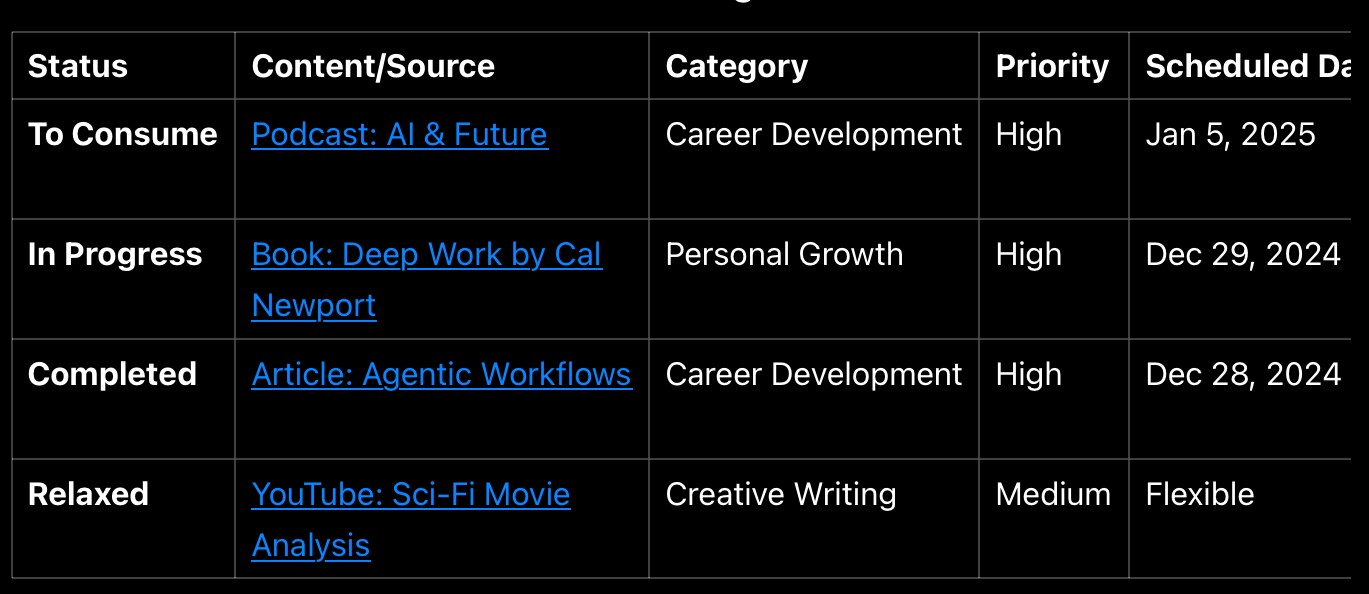
<p>Each item will include details like:</p>

<ul>
  <li><strong>Content/Source</strong>: Name or link to the resource.</li>
  <li><strong>Category</strong>: Goal alignment.</li>
  <li><strong>Priority</strong>: High, Medium, or Low based on their alignment with my goals.</li>
  <li><strong>Scheduled Date</strong>: When I plan to consume it.</li>
</ul>

<p>For example:</p>

<p><img src="/assets/images/2024-12-28-consumption-backlog-template.jpg" alt="Backlog System Template" /></p>

<h3 id="scheduling">Scheduling</h3>

<p>I will dedicate specific time blocks for consumption, such as:</p>

<ul>
  <li><strong>Monday 6am to 10 AM</strong>: Read career-focused articles.</li>
  <li><strong>Wednesday 2-3 PM</strong>: Watch GenAI webinars.</li>
  <li><strong>Friday evening</strong>: Relaxed browsing or YouTube sessions.</li>
</ul>

<h3 id="tools">Tools</h3>

<p>I am still deciding on what tool will help me with this. Since I use Emacs OrgMode a lot, probably will try that first.</p>

<h2 id="a-step-toward-intentional-living">A Step Toward Intentional Living</h2>

<p>This shift isn’t just about consuming knowledge; it’s about fostering a mindset of mindful engagement. By curating what I consume, I hope to reduce distractions, align my learning with my goals, and create a more meaningful relationship with the vast pool of information available. By putting Mindfulness into practice even for my consumption, I hope to declutter my brain and calm myself.</p>

<p>It’s a small but significant step toward living with purpose in a world that often encourages passivity. As I embark on this journey, I look forward to seeing how this practice transforms not just my consumption habits, but the way I approach growth and learning itself.</p>]]></content><author><name>Palak Mathur</name><email>insanethoughts@live.com</email></author><category term="[&quot;Newsletter&quot;]" /><category term="newsletter" /><category term="leadership" /><category term="management" /><category term="productivity" /><summary type="html"><![CDATA[In today’s fast-paced digital world, it’s all too easy to fall into the trap of infinite scrolling, driven by social media algorithms designed to keep us hooked. While these platforms can be valuable, they often lead to unintentional consumption that doesn’t align with our personal or professional goals. For past month or more, I have been consuming Indian High Court Videos on YouTube with no goal in sight and honestly, even though I love watching them, but deep within I am not really happy.]]></summary></entry><entry><title type="html">Eliminating Inequality</title><link href="https://systemhalted.in/newsletter/2024-09-03-eliminating-inequality/" rel="alternate" type="text/html" title="Eliminating Inequality" /><published>2024-09-03T00:00:00+00:00</published><updated>2024-09-03T00:00:00+00:00</updated><id>https://systemhalted.in/newsletter/eliminating-inequality</id><content type="html" xml:base="https://systemhalted.in/newsletter/2024-09-03-eliminating-inequality/"><![CDATA[<p>Last year, I read <em>The Dawn of Everything</em> by David Graeber &amp; David Wengrow. This 704-page monster challenged the deeply entrenched narrative of human history as a linear progression from primitive, egalitarian societies to complex, hierarchical civilizations. The authors, drawing on a wealth of anthropological and archaeological evidence, contest the idea that the advent of agriculture and the rise of cities marked an irreversible slide into social inequality. Their arguments, which stand in stark contrast to the views of many contemporary historians - including my favorite, Yuval Noah Harari - have forced me to reconsider my understanding of inequality and its origins. It has challenged my understanding of civilization trap. I have always tended to simplify history and which I think was fine to be able to detect patterns that would otherwise be invisible. I realize and as both the Davids argue the problem comes when long after the discovery, people continue to simplify.</p>

<p>Graeber and Wengrow argue that agriculture did not necessarily herald the birth of private property or social stratification.</p>

<blockquote>
  <p>Agriculture, in turn, did not mean the inception of private property, nor did it mark an irreversible step towards inequality. In fact, many of the first farming communities were relatively free of ranks and hierarchies. And far from setting class difference in stone, a surprising number of the world’s earliest cities were organized on robustly egalitarian lines, with no need for authoritarian rulers, ambitious warrior-politicians or even bossy administration.</p>
</blockquote>

<p>This counter-narrative raises profound questions: if early societies could be egalitarian, why did inequality become so pervasive? And, more importantly, what does it truly mean to eliminate inequality in our own time?</p>

<h2 id="challenging-the-conventional-narrative">Challenging the Conventional Narrative</h2>

<p>The conventional view of history, as propounded by the likes of Thomas Hobbes and Jean-Jacques Rousseau, posits that inequality is a natural consequence of civilizations’ progress. Hobbes maintains that early humans were savages, while Rousseau maintains “everyone was equal, because they were all equally poor”. As societies grew larger and more complex, hierarchies became necessary to maintain order and distribute resources efficiently. This view suggests that inequality is a necessary trade-off for technological and cultural development.</p>

<p>This view is easy to maintain. It is simple and it helps you “reason” about history. This is the view that I have long held as well. I can have causal relationship between historical events and societal norms. Easy enough to take and pass tests and exams.</p>

<p>However, the Davids challenge this deterministic view. They present evidence that early agricultural societies did not automatically devolve into hierarchical systems. On the contrary, many of these societies operated without rigid social structures, suggesting that inequality is not an inherent feature of human civilization but rather a contingent development - a choice rather than a destiny.</p>

<p>This view invites us to rethink the inevitability of inequality. If early societies managed to maintain egalitarian principles even as they grew in size and complexity, then perhaps inequality is not as unavoidable as we have been led to believe. Instead, it might be a consequence of specific social, political and economic choices made at different but critical junctures in history. Graeber and Wengrow argue that the terms “equality” or “inequality” only began to enter common currency in the early 17th century under the influence of Natural Law Theory.</p>

<h2 id="what-does-it-mean-to-eliminate-inequality">What does it mean to Eliminate Inequality?</h2>

<p>Before we discuss eliminating inequality, we must first define what we mean by equality or inequality. Inequality of wealth is often the first thing that comes to mind, but it represents only one dimension of a much broader issue. There is also inequality of opportunity, inequality in access to education and healthcare, inequality in political power, and even inequality in respect and recognition. Each of these forms of inequality manifests in different ways and require different solutions.</p>

<p>The questions raised by Graeber and Wengrow are crucial: What kind of inequality are we trying to eliminate? Is it enough to redistribute wealth? Or must we also ensure equal access to opportunities? Should we focus on leveling the playing fields or should we aim to equalize the outcomes as well? How equal would people have to be for us to say that we have “eliminated” inequality?</p>

<p>These questions are not just academic. They have real-world implications for policy and governance. Governments and societies have struggled with this. We know just redistribution of wealth doesn’t work - communism and socialism have failed. We cannot probably tackle a single dimension and would likely need a comprehensive approach to eliminating inequality likely requiring us to address multiple dimensions simultaneously.</p>

<h2 id="the-root-causes-of-inequality">The Root Causes of Inequality</h2>

<p>Understanding the root causes of inequality is crucial for developing effective solutions. While economic factors are certainly important, they are not the only drivers of inequality. Cultural, psychological and institutional factors also play their significant roles. For example, the belief that some people are inherently more deserving than others - whether due to birth, intelligence or effort - can perpetuate inequality even in ostensibly egalitarian societies. Similarly, institutions that reinforce social hierarchies, such as the legal system or the education system, can entrench inequality over time. The creation of norms based on gender also lead to similar inequalities.</p>

<p>Graeber and Wengrow’s work suggests that inequality is not a natural consequence of civilization but rather a product of specific social arrangements and ideologies. If this is the case, then it is possible to imagine alternative social arrangements that do not produce the same levels of inequality. However, achieving this will require more than just economic reforms. It will also require a fundamental shift in how we think about equality, merit and justice.</p>

<h2 id="reimagining-equality">Reimagining Equality</h2>

<p>What would it look like to genuinely eliminate inequality in modern society? This is not just a theoretical question but a practical one with profound implications on how we organize our lives - economically, politically and socially.</p>

<p>I have a problem with the use of civilization, the word itself. It means at certain point in history humans became civilized and before that they were mere savages as Hobbes would like us to believe.</p>

<p>One possibility is to rethink the relationship between work and wealth. For example, a universal basic income could ensure that everyone has access to the resources that they need to live a dignified life, regardless of their work status. Alternatively, we could explore more radical ideas, such as decentralized governance models that give communities greater control over their resources and decision-making processes. Like in India, sharpening the teeth of Panchayats.</p>

<p>Another approach might be to focus on eliminating the most extreme forms of inequality first. This could involve redistributive policies that target the wealthiest individuals and corporations, or it could mean prioritizing policies that ensure basic needs - like food, shelter, and healthcare - are met for all.</p>

<p>Whatever the approach, it is clear that eliminating inequality will require us to think creatively and to be willing to challenge deeply held assumptions about how society should be organized. We also need to agree on what inequality means before trying to get rid of it. Even if we adopt some of the measures above, there is an inherent inequality that will stay.</p>

<p>I do not have a solution. However, if we are serious then we must begin by questioning the inevitability of inequality and imagining new possibilities for human organization. First, we must give up on the notion that primitive societies were egalitarian while civilized societies are not; this notion is the root of all evil. Graeber and Wengrow argue that the story will be different if “we treat people from the beginning as imaginative, intelligent, playful creatures” capable of reinventing themselves and their societies. This mindset could help us rethink our place and break free from the “tight conceptual shackles” and imagine the possibility of re-inventing ourselves. Only then we can begin to truly eliminate inequality in all its forms.</p>]]></content><author><name>Palak Mathur</name><email>insanethoughts@live.com</email></author><category term="[&quot;Newsletter&quot;]" /><category term="newsletter" /><category term="leadership" /><category term="management" /><category term="india" /><summary type="html"><![CDATA[Last year, I read The Dawn of Everything by David Graeber &amp; David Wengrow. This 704-page monster challenged the deeply entrenched narrative of human history as a linear progression from primitive, egalitarian societies to complex, hierarchical civilizations. The authors, drawing on a wealth of anthropological and archaeological evidence, contest the idea that the advent of agriculture and the rise of cities marked an irreversible slide into social inequality. Their arguments, which stand in stark contrast to the views of many contemporary historians - including my favorite, Yuval Noah Harari - have forced me to reconsider my understanding of inequality and its origins. It has challenged my understanding of civilization trap. I have always tended to simplify history and which I think was fine to be able to detect patterns that would otherwise be invisible. I realize and as both the Davids argue the problem comes when long after the discovery, people continue to simplify.]]></summary></entry><entry><title type="html">Leading with Humility: Management Lessons from Mahabharata’s Udyoga Parva</title><link href="https://systemhalted.in/newsletter/2024-07-19-leading-with-humility/" rel="alternate" type="text/html" title="Leading with Humility: Management Lessons from Mahabharata’s Udyoga Parva" /><published>2024-07-19T00:00:00+00:00</published><updated>2024-07-19T00:00:00+00:00</updated><id>https://systemhalted.in/newsletter/leading-with-humility</id><content type="html" xml:base="https://systemhalted.in/newsletter/2024-07-19-leading-with-humility/"><![CDATA[<p>Today, I am going to discuss one of the Shlokas from Mahabharata’s Udyoga Parva (Book 5 of 18). Udyoga Parva happens right after the end of Pandava’s exile and the book deals with theory of leadership (Vidura Niti), theory of diplomacy and theory of just war. Here is the Shloka (34.42):</p>

<div class="language-plaintext highlighter-rouge"><div class="highlight"><pre class="highlight"><code>विद्यामदॊ धनमदस तृतीयॊ ऽभिजनॊ मदः
एते मदावलिप्तानाम एत एव सतां दमाः
</code></pre></div></div>

<p>📜 Transliteration:</p>

<div class="language-plaintext highlighter-rouge"><div class="highlight"><pre class="highlight"><code>vidyāmado dhanamadas tṛtīyo 'bhijano madaḥ
ete madāvaliptānām eta eva satāṃ damāḥ
</code></pre></div></div>

<p>Translation:</p>

<p>The shloka talks about three types of prides:</p>

<ol>
  <li><strong>विद्यामदः (Vidyāmadaḥ)</strong>: The pride of knowledge.</li>
  <li><strong>धनमदः (Dhanamadaḥ)</strong>: The pride of wealth.</li>
  <li><strong>अभिजनमदः (Abhijanamadaḥ)</strong>: The pride of noble birth or high lineage.</li>
</ol>

<p>These types of pride can make people arrogant (मदावलिप्तानाम्). However, for virtuous or wise people (सतां), humility or self-control (दमाः) serves as the antidote to these forms of pride.</p>

<p>Let’s look at all three types of prides and what lesson can be drawn from this Shloka.</p>

<h2 id="the-pride-of-knowledge">The Pride of Knowledge</h2>

<p>Leaders and managers are often those who possess deep understanding of their field, innovative ideas, and strategic vision. Knowledge is power and power corrupts.</p>

<p><strong>Lessons in Management:</strong></p>

<ol>
  <li><strong>Continuous Learning</strong>: True leaders never stop learning. They understand that knowledge is ever-evolving and that staying updated is crucial for sustained success. Encouraging a culture of continuous learning within the team can lead to innovation and growth.</li>
  <li><strong>Humility in Knowledge</strong>: Knowledge should lead to wisdom, and wisdom is inherently humble. Leaders who acknowledge that they don’t know everything are more likely to inspire trust and collaboration within their teams. This humility fosters an environment where team members feel valued and are more willing to contribute their insights.</li>
  <li><strong>Mentorship and Sharing</strong>: Knowledge should be shared, not hoarded. Great leaders mentor their teams, share their expertise, and empower others. This approach not only builds a stronger team but also ensures the leader’s legacy and influence extend beyond their tenure.</li>
</ol>

<h2 id="the-pride-of-wealth">The Pride of Wealth</h2>

<p>Wealth, in the context of management, often translates to resources - financial, technological, or human. Leaders who manage substantial resources can sometimes fall into the trap of believing that wealth alone is sufficient to ensure success.</p>

<p><strong>Lessons in Management:</strong></p>

<ol>
  <li><strong>Resource Optimization</strong>: Effective management involves optimizing resources, not just amassing them. Leaders should focus on how resources are allocated and used to achieve strategic goals. This requires careful planning, monitoring, and adjusting based on performance and changing circumstances.</li>
  <li><strong>Ethical Management</strong>: Wealth should be managed ethically. Leaders who prioritize ethical considerations in their decisions build a culture of integrity and trust within their organizations. This not only enhances the company’s reputation but also attracts and retains top talent.</li>
  <li><strong>Investment in People</strong>: The most valuable resource in any organization is its people. Leaders should invest in their teams, providing opportunities for professional growth and creating an environment where employees feel valued and motivated.</li>
</ol>

<h2 id="the-pride-of-noble-birth">The Pride of Noble Birth</h2>

<p>The noble birth can be likened to pedigree - coming from prestigious institutions, having high-profile networks, or belonging to influential families. While these can provide a head start, relying solely on pedigree can lead to complacency.</p>

<p><strong>Lessons in Management:</strong></p>

<ol>
  <li><strong>Performance Over Pedigree</strong>: Effective leaders are those who prioritize performance over pedigree. They recognize that success is driven by results, not just by background. This meritocratic approach ensures that the most capable individuals are in positions where they can make the most impact.</li>
  <li><strong>Building Diverse Teams</strong>: Diversity in backgrounds, experiences, and perspectives can lead to more innovative solutions and better decision-making. Leaders should strive to build diverse teams, valuing what each member brings to the table regardless of their pedigree.</li>
  <li><strong>Cultivating Humility</strong>: Leaders should cultivate humility, recognizing that their background does not entitle them to success. This mindset fosters a willingness to learn from others, seek feedback, and continuously improve.</li>
</ol>

<h2 id="the-virtue-of-humility-and-self-control">The Virtue of Humility and Self-Control</h2>

<p>The shloka emphasizes that for the wise (सतां), humility and self-control (दमाः) are the antidotes to pride. In management, these virtues are indispensable.</p>

<p><strong>Lessons in Management:</strong></p>

<ol>
  <li><strong>Leading by Example</strong>: Leaders who exhibit humility and self-control set a powerful example for their teams. This behavior encourages a culture of respect, integrity, and continuous improvement. Employees are more likely to emulate these virtues, leading to a more cohesive and effective organization.</li>
  <li><strong>Emotional Intelligence</strong>: Self-control is a key component of emotional intelligence. Leaders who can manage their emotions, especially in stressful situations, are better equipped to make rational decisions and maintain a positive work environment.</li>
  <li><strong>Empathy and Compassion</strong>: Humility fosters empathy and compassion, qualities that are crucial for effective leadership. Leaders who understand and address the needs and concerns of their team members build strong, loyal, and motivated teams.</li>
</ol>

<h2 id="conclusion">Conclusion</h2>

<p>In the end everything boils down to one thing - be mindful in your leadership. Knowledge is power and power corrupts and so is true for wealth and lineage. Humility and self-control are important tools that can help us leaders create a positive, productive and ethical workspace.</p>]]></content><author><name>Palak Mathur</name><email>insanethoughts@live.com</email></author><category term="[&quot;Newsletter&quot;]" /><category term="newsletter" /><category term="leadership" /><category term="management" /><category term="india" /><summary type="html"><![CDATA[Today, I am going to discuss one of the Shlokas from Mahabharata’s Udyoga Parva (Book 5 of 18). Udyoga Parva happens right after the end of Pandava’s exile and the book deals with theory of leadership (Vidura Niti), theory of diplomacy and theory of just war. Here is the Shloka (34.42):]]></summary></entry><entry><title type="html">6 Degrees of Freedom: Exploring Personal Autonomy in a Modern World</title><link href="https://systemhalted.in/newsletter/2024-07-16-six-degrees-of-freedom/" rel="alternate" type="text/html" title="6 Degrees of Freedom: Exploring Personal Autonomy in a Modern World" /><published>2024-07-16T00:00:00+00:00</published><updated>2024-07-16T00:00:00+00:00</updated><id>https://systemhalted.in/newsletter/six-degrees-of-freedom</id><content type="html" xml:base="https://systemhalted.in/newsletter/2024-07-16-six-degrees-of-freedom/"><![CDATA[<p>Today the quest for personal freedom and autonomy is more relevant than ever. While traditional markers of success have often included career achievements and material possessions, many are now redefining what it means to be truly “free.” Recently, a conversation with a colleague got me thinking about how personal freedom can be achieved - how one can move through life carefree, pursuing passions without hesitation. This led me to consider six degrees of freedom that can contribute to a life of greater flexibility and independence in terms of career choices, geographical mobility, and personal time. At the same time, it’s important to recognize how the absence of these freedoms might impose constraints on these areas of life.</p>

<p><strong>Important Note</strong>:</p>

<p>This article is not a recommendation or value judgment about life choices such as marriage or having children. It’s an exploration of how certain responsibilities and commitments can impact personal autonomy. Each person’s journey is unique and these are just my observations in the passing and not a thoroughly researched paper.</p>

<h1 id="six-degrees-of-freedom">Six Degrees of Freedom</h1>

<p>Before we discuss six degrees of freedom, let’s first define what being free means for this discussion. These are the freedoms that are outcome of our degrees of freedom that we discuss in next section.</p>

<p><strong>Career Flexibility</strong>: The ability to make choices and changes in one’s career path without significant constraints. This includes pursuing different roles, industries, or working arrangements that align with personal goals and values.
<strong>Geographical Freedom</strong>: The freedom to choose and relocate to different locations based on personal preferences or opportunities without being restricted by factors such as financial obligations, family responsibilities, or other ties.
<strong>Time Freedom</strong>: Having control over one’s schedule and the ability to allocate time according to personal priorities, interests, and needs. It involves having sufficient leisure time and flexibility in daily routines to pursue hobbies, personal development, or leisure activities.</p>

<p>Now, let’s discuss the six degrees of freedom and the impact of their lack on each of the above freedoms.</p>

<ol>
  <li><strong>Debt Free</strong></li>
</ol>

<p><strong>Observation</strong>: Financial freedom is foundational to personal autonomy. Being debt-free—whether from mortgages, student loans, or car loans—provides the ability to make career choices based on passion rather than necessity.</p>

<p><strong>Impact</strong>:</p>

<p>• <strong>Career Flexibility</strong>: Without the burden of debt, individuals can pursue careers that align with their interests and values, even if they come with lower salaries.</p>

<p>• <strong>Geographical Freedom</strong>: Freedom from debt allows for relocation without the worry of managing high living costs or finding high-paying jobs.</p>

<p>• <strong>Time Freedom</strong>: Lower financial obligations mean fewer working hours needed to stay afloat, creating more personal time.</p>

<ol>
  <li><strong>Kids Free</strong></li>
</ol>

<p><strong>Observation</strong>: Parenting is a deeply fulfilling role for many, but it also introduces responsibilities that can impact personal freedom.</p>

<p><strong>Impact</strong>:</p>

<p>• <strong>Career Flexibility</strong>: Parents often seek stable, higher-paying jobs with benefits, potentially limiting the ability to make significant career changes or take breaks.</p>

<p>• <strong>Geographical Freedom</strong>: Children’s educational and social needs can anchor families to specific locations.</p>

<p>• Time Freedom: Raising children requires significant time and energy, reducing available hours for personal or professional pursuits.</p>

<ol>
  <li><strong>Unmarried</strong></li>
</ol>

<p><strong>Observation</strong>: Marriage involves shared responsibilities and decision-making, which can impact individual autonomy.</p>

<p><strong>Impact</strong>:</p>

<p>• <strong>Career Flexibility</strong>: Financial and emotional dependencies in marriage might influence career decisions, requiring consideration of a partner’s needs and goals.</p>

<p>• <strong>Geographical Freedom</strong>: Relocation decisions become more complex when accounting for a partner’s career and familial ties.</p>

<p>• <strong>Time Freedom</strong>: Shared responsibilities in a marriage can reduce the flexibility to manage personal time independently.</p>

<ol>
  <li><strong>No Parents’ Responsibilit</strong>y</li>
</ol>

<p><strong>Observation</strong>: Caring for aging parents is a noble and important duty, but it also introduces significant commitments.</p>

<p><strong>Impact</strong>:</p>

<p>• <strong>Career Flexibility</strong>: Providing care for parents often necessitates job stability and proximity, which can limit career changes or relocations.</p>

<p>• <strong>Geographical Freedom</strong>: Caregiving responsibilities can tie individuals to specific locations, making it challenging to move.</p>

<p>• <strong>Time Freedom</strong>: Regular caregiving duties can significantly reduce the time available for work and leisure.</p>

<ol>
  <li><strong>Minimalist Lifestyle</strong></li>
</ol>

<p><strong>Observation</strong>: Embracing a minimalist lifestyle reduces material possessions and the associated burdens, contributing to greater freedom.</p>

<p><strong>Impact</strong>:</p>

<p>• <strong>Career Flexibility</strong>: Lower financial pressures allow for more freedom to explore career changes or take up fulfilling but lower-paying jobs.</p>

<p>• <strong>Geographical Freedom</strong>: Fewer possessions make relocating easier and less costly.</p>

<p>• <strong>Time Freedom</strong>: Less time spent managing and maintaining possessions increases available personal time.</p>

<ol>
  <li><strong>Health Independence</strong></li>
</ol>

<p><strong>Observation</strong>: Good health is essential for maintaining autonomy and the ability to engage fully in personal and professional activities.</p>

<p><strong>Impact</strong>:</p>

<p>• <strong>Career Flexibility</strong>: Good health supports job performance and the ability to pursue physically or mentally demanding roles.</p>

<p>• <strong>Geographical Freedom</strong>: Without specific health concerns, individuals are not tied to locations with particular medical facilities or climates.</p>

<p>• <strong>Time Freedom</strong>: Good health reduces time spent on medical appointments or managing chronic conditions, freeing up more personal time.</p>

<h2 id="conclusion">Conclusion</h2>

<p>The six degrees of freedom discussed are just some of the ways personal autonomy can be influenced. This article is intended to spark thought and discussion, not to suggest that these are the only paths to freedom or that certain life choices are inherently better than others. Everyone’s path to freedom and fulfillment is personal and valid. It’s about finding the balance that works for you and recognizing how various factors can interplay to shape your life’s flexibility and independence.</p>]]></content><author><name>Palak Mathur</name><email>insanethoughts@live.com</email></author><category term="[&quot;Newsletter&quot;]" /><category term="newsletter" /><category term="leadership" /><category term="management" /><summary type="html"><![CDATA[Today the quest for personal freedom and autonomy is more relevant than ever. While traditional markers of success have often included career achievements and material possessions, many are now redefining what it means to be truly “free.” Recently, a conversation with a colleague got me thinking about how personal freedom can be achieved - how one can move through life carefree, pursuing passions without hesitation. This led me to consider six degrees of freedom that can contribute to a life of greater flexibility and independence in terms of career choices, geographical mobility, and personal time. At the same time, it’s important to recognize how the absence of these freedoms might impose constraints on these areas of life.]]></summary></entry><entry><title type="html">The State of Gurgaon: A City of Promises and Pitfalls</title><link href="https://systemhalted.in/newsletter/2024-07-14-the-state-of-gurgaon/" rel="alternate" type="text/html" title="The State of Gurgaon: A City of Promises and Pitfalls" /><published>2024-07-14T00:00:00+00:00</published><updated>2024-07-14T00:00:00+00:00</updated><id>https://systemhalted.in/newsletter/the-state-of-gurgaon</id><content type="html" xml:base="https://systemhalted.in/newsletter/2024-07-14-the-state-of-gurgaon/"><![CDATA[<p>Gurgaon, also known as Gurugram, stands as a paradox in the Indian urban landscape. It’s a city that embodies modernity, boasting some of the most impressive skyscrapers, luxury apartments, and expansive malls in the country. Yet, beneath this veneer of opulence lies a web of infrastructural deficiencies, particularly concerning the state of its roads, which starkly contrasts the city’s aspirations of becoming a world-class urban center.</p>

<h1 id="the-rise-of-gurgaon">The Rise of Gurgaon</h1>

<p>I remember visiting Gurgaon in 1987 when a relation built a house in DLF. It was a city far away from Delhi, or so it seemed. Gurgaon’s transformation began in the early 1990s, riding the wave of economic liberalization in India. Its proximity to New Delhi and the establishment of the Delhi-Gurgaon Expressway catalyzed its development, attracting multinational corporations, IT giants, and affluent residents. Over the past three decades, Gurgaon has evolved from a sleepy suburb to a bustling metropolis, often dubbed the “Millennium City.”</p>

<p>This rapid urbanization brought significant economic benefits. The city’s skyline, dotted with high-rise buildings, reflects the growth of its corporate sector. The influx of global companies has created employment opportunities and fostered an ecosystem of startups and ancillary businesses. The city’s residential landscape has similarly transformed, with upscale housing societies and gated communities catering to the affluent. And with the opening of Dwarka Expressway, this all will seem to be just a trailer.</p>

<h1 id="the-urban-planning-conundrum">The Urban Planning Conundrum</h1>

<p>However, the meteoric rise of Gurgaon has not been matched by an equivalent focus on urban planning and infrastructure development. The city’s roads, a critical component of its infrastructure, are emblematic of these shortcomings. Despite being one of the most expensive cities in India, the condition of Gurgaon’s roads is dismal, characterized by potholes, uneven surfaces, and frequent waterlogging.</p>

<p>The lack of a coherent city plan is evident in the haphazard development of road networks. Many roads in Gurgaon were not designed to accommodate the high volume of traffic they now bear. Consequently, traffic congestion is a daily ordeal for commuters, exacerbated by the poor quality of the roads. The situation is particularly dire in monsoon seasons, when inadequate drainage systems lead to severe water-logging, further deteriorating the already fragile road surfaces.</p>

<h2 id="old-gurgaon-new-gurgaon-and-beyond">Old Gurgaon, New Gurgaon, and Beyond</h2>

<p>The Haryana Government’s attempts to revamp Gurgaon into a world-class city have involved creating distinct zones: Old Gurgaon, Gurgaon, and New Gurgaon. However, this segmentation has not yielded the desired improvements in infrastructure. Each of these areas suffers from similar issues, primarily stemming from inadequate city planning and poor execution of development projects.</p>

<p>Old Gurgaon, the original heart of the city, is plagued by narrow, congested streets that are ill-equipped to handle modern traffic demands. The commercial hubs in this area struggle with inadequate parking facilities and frequent power outages, adding to the woes of residents and business owners alike.</p>

<p>The central part of Gurgaon, which houses the iconic Cyber City and other major commercial zones, fares slightly better in terms of infrastructure. However, even here, the roads are far from world-class standards. Traffic bottlenecks are common, and the absence of proper pedestrian pathways makes it perilous for those who prefer to walk.</p>

<p>New Gurgaon, envisioned as a meticulously planned urban area, is perhaps the biggest disappointment. Despite being marketed as the city’s future, it suffers from the same infrastructural neglect that plagues the older parts. Many newly constructed roads have deteriorated rapidly, raising questions about the quality of materials used and the oversight of construction projects.</p>

<h2 id="the-cost-of-neglect">The Cost of Neglect</h2>

<p>The state of Gurgaon’s roads has significant economic and social implications. Frequent traffic jams lead to lost productivity, as employees spend hours stuck in their vehicles. The wear and tear on vehicles caused by poor road conditions translate to higher maintenance costs for residents. More importantly, the safety risks posed by these roads cannot be overstated. Accidents caused by potholes and uneven surfaces are common, endangering the lives of commuters.</p>

<p>Moreover, the infrastructural deficiencies undermine Gurgaon’s appeal as a global business hub. While the city attracts significant foreign investment, the subpar infrastructure can be a deterrent for potential investors and expatriates. For a city that aspires to compete with international business centers, the current state of its roads is a glaring shortfall.</p>

<h2 id="the-mentality-to-not-follow-traffic-rules">The Mentality to Not Follow Traffic Rules</h2>

<p>A critical, yet often overlooked, aspect contributing to the chaotic traffic and deteriorating road conditions in Gurgaon is the prevalent mentality of not following traffic rules. This behavioral issue exacerbates the infrastructural deficiencies, creating an environment of disorder and increased risk on the roads. This issue is not just of Gurgaon, whole India is plagued with this with government and its officers looking sideways doing nothing to improve the conditions other than using traffic anomalies to fill their coffers.</p>

<p>In Gurgaon, the disregard for traffic rules manifests in various forms. Jumping red lights, lane indiscipline, over-speeding, and wrongful parking are common practices. Many drivers exhibit a sense of entitlement, believing they can circumvent traffic laws without facing consequences. This attitude is often a byproduct of inadequate enforcement of traffic regulations, coupled with a lack of civic sense among road users.</p>

<p>The repercussions of this mentality are far-reaching. Traffic congestion is significantly worsened by drivers who do not adhere to lane discipline, causing bottlenecks at intersections and narrow roads. The tendency to park vehicles haphazardly on the roadside further reduces the effective width of roads, complicating the flow of traffic. Over-speeding and reckless driving heighten the risk of accidents, which are already prevalent due to poor road conditions.</p>

<p>The lack of adherence to traffic rules also undermines the safety of pedestrians and cyclists. In many parts of Gurgaon, footpaths are either non-existent or encroached upon, forcing pedestrians to walk on the road. This situation is perilous in an environment where drivers frequently disregard traffic signals and pedestrian crossings.</p>

<h2 id="water-logging-and-flash-floods">Water-logging and Flash Floods</h2>

<p>One of the most pressing issues that Gurgaon faces is waterlogging and flash floods, even after a short spell of rain. Despite its modern facade, the city’s drainage system is inadequate to handle heavy rainfall, leading to severe water-logging that disrupts daily life and exacerbates road conditions.</p>

<h2 id="reasons-for-water-logging-and-flash-floods">Reasons for Water-logging and Flash Floods:</h2>

<ol>
  <li><strong>Poor Drainage Systems</strong>: Gurgaon’s drainage infrastructure has not kept pace with its rapid urbanization. Many areas lack proper stormwater drains, and existing drains are often clogged with debris and unplanned construction.</li>
  <li><strong>Unplanned Urbanization</strong>: The rapid development of Gurgaon has often been haphazard, with little regard for natural water flow patterns. Construction on wetlands and natural drainage channels has significantly reduced the city’s ability to manage rainfall effectively.</li>
  <li><strong>Inadequate Maintenance</strong>: Even where drainage systems exist, they are often poorly maintained. Regular cleaning and desilting of drains are neglected, leading to blockages that cause water to accumulate on roads.</li>
  <li><strong>Impermeable Surfaces</strong>: The extensive use of concrete and asphalt in urban development has reduced the number of permeable surfaces that can absorb rainwater. This increases surface runoff, contributing to water-logging.</li>
</ol>

<h2 id="a-path-forward">A Path Forward</h2>

<p>Addressing the infrastructural challenges of Gurgaon requires a multifaceted approach, focusing on both immediate improvements and long-term planning.</p>

<h3 id="solutions-for-road-conditions">Solutions for Road Conditions</h3>

<h4 id="road-repair-and-maintenance">Road Repair and Maintenance:</h4>

<p>Immediate Action: Filling potholes and resurfacing roads to ensure smooth and safe travel.
Long-term Action: Regular maintenance schedules to keep roads in good condition.</p>

<h4 id="improved-construction-quality">Improved Construction Quality:</h4>

<p>Using high-quality materials and modern construction techniques to build durable roads.
Implementing strict oversight and accountability for construction projects to prevent shoddy workmanship.</p>

<h4 id="enhanced-city-planning">Enhanced City Planning:</h4>

<p>Developing a coherent and comprehensive road network plan that accommodates current and future traffic demands.
Incorporating sustainable practices such as green belts and dedicated pedestrian pathways.</p>

<h3 id="solutions-for-water-logging-and-flash-floods">Solutions for Water-logging and Flash Floods</h3>

<h4 id="upgrading-drainage-infrastructure">Upgrading Drainage Infrastructure:</h4>

<p>Constructing new stormwater drains and expanding existing ones to handle heavy rainfall.
Ensuring drains are properly sized and strategically placed to prevent water accumulation.</p>

<h4 id="regular-maintenance">Regular Maintenance:</h4>

<p>Instituting a rigorous maintenance schedule for cleaning and desilting drains to prevent blockages.</p>

<h4 id="sustainable-urban-planning">Sustainable Urban Planning:</h4>

<p>Preserving natural drainage channels, wetlands, and green spaces to absorb rainwater.
Promoting the use of permeable materials for pavements and other surfaces to reduce surface runoff.</p>

<h4 id="rainwater-harvesting">Rainwater Harvesting:</h4>

<p>Encouraging residential and commercial buildings to adopt rainwater harvesting systems to manage rainfall more effectively.</p>

<h3 id="solutions-for-traffic-rule-adherence">Solutions for Traffic Rule Adherence</h3>

<h4 id="enforcement-of-traffic-laws">Enforcement of Traffic Laws:</h4>

<p>Increasing surveillance through traffic cameras and imposing stricter penalties for violations.
Ensuring consistent enforcement to deter habitual offenders.</p>

<h4 id="public-awareness-campaigns">Public Awareness Campaigns:</h4>

<p>Educating the public about the importance of traffic rules and the impact of violations on safety and congestion.
Highlighting the civic responsibility of road users through media and community engagement.</p>

<h4 id="road-safety-education">Road Safety Education:</h4>

<p>Incorporating road safety education into school curriculums to instill responsible behavior in young citizens.</p>

<h4 id="community-engagement">Community Engagement:</h4>

<p>Involving residents in traffic management initiatives and awareness drives to foster a culture of compliance with traffic rules.</p>

<h3 id="leveraging-artificial-intelligence">Leveraging Artificial Intelligence</h3>

<p>Artificial Intelligence (AI) offers innovative solutions to address many of Gurgaon’s infrastructural challenges. AI can enhance urban planning, traffic management, and infrastructure maintenance, leading to a more efficient and sustainable urban environment.</p>

<ol>
  <li><strong>Smart Traffic Management</strong>:</li>
</ol>

<p><em>AI-Powered Traffic Lights</em>: AI can optimize traffic light timings based on real-time traffic flow data, reducing congestion and improving traffic efficiency.
<em>Predictive Analytics</em>: AI algorithms can analyze traffic patterns and predict congestion, allowing authorities to take proactive measures to manage traffic flow.
<em>Dynamic Routing</em>: AI can provide real-time route suggestions to drivers, helping them avoid congested areas and reducing overall traffic volume on major roads.</p>

<ol>
  <li><strong>Infrastructure Maintenance</strong>:</li>
</ol>

<p><em>Automated Inspections</em>: AI-powered drones and sensors can conduct regular inspections of roads and drainage systems, identifying issues like potholes or blockages before they become severe.
<em>Predictive Maintenance</em>: Machine learning models can predict when and where maintenance is needed, allowing for timely repairs and reducing the long-term costs associated with infrastructure deterioration.</p>

<ol>
  <li><strong>Water Management</strong>:</li>
</ol>

<p><em>Smart Drainage Systems</em>: AI can monitor and control drainage systems in real-time, ensuring efficient water flow and preventing blockages that lead to waterlogging.
<em>Flood Prediction and Management</em>: AI can analyze weather patterns and historical data to predict flash floods, enabling authorities to take preventive measures and issue timely warnings to residents.</p>

<ol>
  <li><strong>Urban Planning</strong>:</li>
</ol>

<p><em>Simulation and Modeling</em>: AI can simulate the impact of new construction projects on traffic and drainage systems, helping urban planners make informed decisions.
<em>Data-Driven Planning</em>: By analyzing data on population growth, traffic patterns, and environmental factors, AI can assist in creating more sustainable and efficient city plans.</p>

<ol>
  <li><strong>Enhancing Traffic Rule Adherenc</strong>e:</li>
</ol>

<p><em>Automated Enforcement</em>: AI-powered cameras can monitor traffic in real-time, identifying and recording traffic violations. This can ensure consistent enforcement of traffic rules.
<em>Behavioral Analysis</em>: AI can analyze driver behavior patterns to identify high-risk behaviors and areas with frequent violations, allowing for targeted interventions.
<em>Public Awareness and Education</em>: AI-driven platforms can personalize traffic safety education programs for different demographics, enhancing their effectiveness.</p>

<p>I hope that leaders in the city take cognizance of the issues and take action rather than playing low-level politics. Gurgaon’s journey from a nondescript suburb to a major urban center is a testament to the possibilities of rapid economic development. However, the city’s infrastructural deficiencies, particularly its roads, threaten to undermine its progress. By leveraging AI and other innovative solutions, Gurgaon can address these challenges effectively and realize its vision of becoming a world-class city. Prioritizing robust city planning and sustainable infrastructure development is crucial for creating a modern, livable city that meets the aspirations of its residents and the demands of its burgeoning corporate sector.</p>]]></content><author><name>Palak Mathur</name><email>insanethoughts@live.com</email></author><category term="[&quot;Newsletter&quot;]" /><category term="newsletter" /><category term="leadership" /><category term="management" /><category term="india" /><summary type="html"><![CDATA[Gurgaon, also known as Gurugram, stands as a paradox in the Indian urban landscape. It’s a city that embodies modernity, boasting some of the most impressive skyscrapers, luxury apartments, and expansive malls in the country. Yet, beneath this veneer of opulence lies a web of infrastructural deficiencies, particularly concerning the state of its roads, which starkly contrasts the city’s aspirations of becoming a world-class urban center.]]></summary></entry><entry><title type="html">The Hidden Cost of Ineffective Product Evaluation in Software Engineering</title><link href="https://systemhalted.in/newsletter/2024-07-01-hidden-cost-of-ineffective-product-evaluation/" rel="alternate" type="text/html" title="The Hidden Cost of Ineffective Product Evaluation in Software Engineering" /><published>2024-07-01T00:00:00+00:00</published><updated>2024-07-01T00:00:00+00:00</updated><id>https://systemhalted.in/newsletter/hidden-cost-of-ineffective-product-evaluation</id><content type="html" xml:base="https://systemhalted.in/newsletter/2024-07-01-hidden-cost-of-ineffective-product-evaluation/"><![CDATA[<h1 id="introduction">Introduction</h1>

<p>In the fast-paced world of software engineering, the pressure to deliver new products and features quickly can be intense. However, failing to properly evaluate the value of a product or its features before development begins can have significant negative consequences. This oversight not only impacts the efficiency and morale of development teams but can also lead to substantial financial losses for companies and even harm the environment. Furthermore, this approach stands in stark contrast to the principles outlined in the Agile Manifesto, which emphasizes the importance of delivering valuable software.</p>

<h1 id="the-importance-of-evaluating-product-value">The Importance of Evaluating Product Value</h1>

<p>Evaluating product value involves understanding the potential impact and benefit a product or feature will bring to users and the organization. This process typically includes market research, user feedback, user empathy sessions, cost-benefit analysis, and feasibility studies. When done effectively, it ensures that resources are invested in initiatives that provide the greatest return on investment (ROI) and align with strategic goals.</p>

<p>I have had my share of few products that were developed without proper evaluation (and in one case even after the evaluation suggested an alternative action) only to be shutdown months later. The loss is eventually financial, the cost is much more than that.</p>

<p>The Cost of Ineffective Product Evaluation</p>

<ol>
  <li><strong>Waste of Resources</strong> 🚮:</li>
</ol>

<p>Developing products or features without proper evaluation often leads to investing significant time, money, and human resources into initiatives that may not meet user needs or business objectives. This misallocation of resources can result in substantial financial waste and opportunity costs.</p>

<ol>
  <li><strong>Impact on Team Morale</strong> 📉🎯:</li>
</ol>

<p>Teams that work on poorly conceived projects are likely to experience frustration and demotivation. When their hard work does not result in successful products or when features are discarded post-development, it can lead to burnout and a high turnover rate.</p>

<ol>
  <li><strong>Environmental Consequences</strong> 🌏⚠️:</li>
</ol>

<p>The environmental impact of software development is an often overlooked but critical consideration. Building and maintaining software consumes energy and resources, contributing to carbon emissions and electronic waste. Developing unnecessary or redundant products and/or features exacerbates these environmental impacts. More on this in a future post.</p>

<ol>
  <li><strong>Loss of Competitive Edge</strong> ⛔️🏆:</li>
</ol>

<p>Companies that fail to evaluate product value risk falling behind competitors who are more strategic in their development efforts. This can lead to a loss of market share and reduced profitability.</p>

<ol>
  <li><strong>User Dissatisfaction</strong> 🙁:</li>
</ol>

<p>When products or features do not address real user needs or deliver the promised value, user satisfaction plummets. This can lead to negative reviews, decreased user retention, and damage to the company’s reputation.</p>

<h1 id="agile-manifesto-a-framework-for-value-driven-development">Agile Manifesto: A Framework for Value-Driven Development</h1>

<p>The Agile Manifesto, introduced in 2001, revolutionized software development by emphasizing individuals and interactions, working software, customer collaboration, and responding to change over rigid processes and documentation. Key principles of the Agile Manifesto include delivering valuable software and continuously seeking feedback to improve and adapt.</p>

<ol>
  <li><strong>Customer Collaboration Over Contract Negotiation</strong> 🤝:</li>
</ol>

<p>Agile methodologies prioritize close collaboration with customers to understand their needs and ensure the delivered product provides real value. Skipping proper evaluation contradicts this principle by potentially leading to products that do not meet customer needs.</p>

<ol>
  <li><strong>Working Software Over Comprehensive Documentation</strong> 👨💻:</li>
</ol>

<p>Agile promotes the delivery of functional software over excessive documentation. However, this does not mean bypassing critical evaluation steps. Ensuring the software being built is valuable is fundamental to this principle.</p>

<ol>
  <li><strong>Responding to Change Over Following a Plan</strong> 🔄:</li>
</ol>

<p>Agile teams are encouraged to be adaptable and responsive to change. Properly evaluating product value helps teams pivot effectively when necessary, ensuring they are always working on the most valuable and relevant features.</p>

<ol>
  <li><strong>Continuous Delivery of Valuable Software</strong> 📦:</li>
</ol>

<p>One of the core tenets of Agile is the continuous delivery of valuable software. Without proper evaluation, the likelihood of delivering truly valuable software diminishes, undermining the essence of Agile.</p>

<h1 id="strategies-for-effective-product-evaluation">Strategies for Effective Product Evaluation</h1>

<ol>
  <li><strong>User-Centered Design and Feedback Loop</strong>s 👥🔄:</li>
</ol>

<p>Implementing user-centered design involves regularly engaging with users through surveys, interviews, and usability testing. These feedback loops ensure that the development team understands user needs and pain points, guiding them to create valuable products.</p>

<ol>
  <li><strong>Minimum Viable Product (MVP)</strong> 🚀:</li>
</ol>

<p>Developing an MVP allows teams to test a product’s core functionality with minimal resources. This approach provides early user feedback and helps validate assumptions about the product’s value before committing to full-scale development.</p>

<ol>
  <li><strong>Cost-Benefit Analysis</strong> 💸🧐:</li>
</ol>

<p>Conducting a thorough cost-benefit analysis helps quantify the potential ROI of a product or feature. This analysis should consider both tangible and intangible benefits, including user satisfaction and brand loyalty.</p>

<ol>
  <li><strong>Market Research</strong> 🔍📈:</li>
</ol>

<p>Understanding market trends, competitor offerings, and potential demand is crucial. Market research provides insights that inform strategic decisions about which products or features are worth pursuing.</p>

<ol>
  <li><strong>Agile Metrics</strong> 📐:</li>
</ol>

<p>Utilizing metrics such as customer satisfaction scores, user engagement rates, and development cycle time can help teams measure the value delivered by their efforts. These metrics provide data-driven insights for continuous improvement.</p>

<h1 id="aligning-product-development-with-agile-principles">Aligning Product Development with Agile Principles</h1>

<ol>
  <li><strong>Prioritizing Value</strong> 🏅:</li>
</ol>

<p>Agile teams should prioritize work that delivers the highest value. This requires ongoing evaluation and re-evaluation of product features and initiatives to ensure alignment with user needs and business goals.</p>

<ol>
  <li><strong>Empowering Team</strong>s 🧰:</li>
</ol>

<p>Agile emphasizes empowering teams to make decisions. Providing teams with the tools and data to evaluate product value empowers them to make informed decisions and focus on meaningful work.</p>

<ol>
  <li><strong>Fostering Collaboration</strong> 🤝:</li>
</ol>

<p>Collaboration between developers, product managers, and stakeholders is critical. Regular communication and feedback loops help ensure that everyone is aligned on the product’s value and strategic direction.</p>

<ol>
  <li><strong>Iterative Development</strong> 🔁:</li>
</ol>

<p>Agile’s iterative approach allows teams to continuously deliver and refine valuable software. Each iteration provides an opportunity to reassess the product’s value and make necessary adjustments.</p>

<h1 id="conclusion">Conclusion</h1>

<p>Properly evaluating product value before embarking on development is crucial for the success of software engineering projects. It ensures that resources are used efficiently, teams remain motivated 🎯, and environmental impacts are minimized 🌍⚠️. Moreover, it aligns with the core principles of the Agile Manifesto, fostering a culture of delivering valuable software through collaboration, feedback, and adaptability.</p>

<p>By adopting strategies such as user-centered design, MVP development, cost-benefit analysis, and market research, organizations can enhance their ability to evaluate product value effectively. This approach not only mitigates the risks associated with ineffective product evaluation but also positions companies to deliver software that truly meets user needs and drives business success. In doing so, teams can uphold the spirit of the Agile Manifesto and contribute to a more sustainable and value-driven software development ecosystem.</p>]]></content><author><name>Palak Mathur</name><email>insanethoughts@live.com</email></author><category term="[&quot;Newsletter&quot;]" /><category term="newsletter" /><category term="leadership" /><category term="management" /><category term="product management" /><category term="user-centered design" /><category term="sustainability" /><category term="software engineering" /><category term="agile" /><category term="human-centered design" /><summary type="html"><![CDATA[Introduction]]></summary></entry><entry><title type="html">Balancing Diplomacy and Firmness - Insights from Ancient Wisdom</title><link href="https://systemhalted.in/newsletter/2024-06-28-balancing-diplomacy-firmness/" rel="alternate" type="text/html" title="Balancing Diplomacy and Firmness - Insights from Ancient Wisdom" /><published>2024-06-28T00:00:00+00:00</published><updated>2024-06-28T00:00:00+00:00</updated><id>https://systemhalted.in/newsletter/balancing-diplomacy-firmness</id><content type="html" xml:base="https://systemhalted.in/newsletter/2024-06-28-balancing-diplomacy-firmness/"><![CDATA[<p>In the rapidly evolving tech industry, effective leadership and management hinge on the principles of diplomacy and strategic thinking. Tech leaders are constantly navigating through conflicts, tough situations, and sometimes dealing with downright difficult people. While contemporary management theories offer a plethora of strategies, there’s a wealth of timeless wisdom to be gleaned from ancient texts. One such powerful lesson comes from the Panchatantra, an ancient Indian collection of interrelated animal fables in Sanskrit śloka (verse) and prose.</p>

<p>Consider this śloka:</p>

<div class="language-plaintext highlighter-rouge"><div class="highlight"><pre class="highlight"><code>नवनीतसमां वाणीं कृत्वा चित्तं तु निर्दयम्।
तथा प्रबोध्यते शत्रुः सान्वयो म्रियते यथा॥
</code></pre></div></div>

<div class="language-plaintext highlighter-rouge"><div class="highlight"><pre class="highlight"><code>Navanītasamāṁ vāṇīṁ kṛtvā cittaṁ tu nirdayam।
Tathā prabodhyate śatruḥ sānvayo mriyate yathā॥
</code></pre></div></div>

<p>Translated, it means:</p>

<blockquote>
  <p>With speech as smooth as butter and a heart devoid of compassion, one can defeat an enemy, leading to his downfall along with his kin.</p>
</blockquote>

<p>At first glance, this verse might seem ruthless, advocating a strategy of manipulation and heartlessness. And it might be true in the era it was written. However, if we delve deeper and interpret it through the lens of modern leadership, we can extract valuable lessons on maintaining a composed and tactful demeanor even when facing challenges or opposition. This is not about destroying anyone but about effectively navigating through adversities with strategic acumen and emotional intelligence. This is the liberty that I take here to reinterpret this śloka.</p>

<h1 id="the-art-of-balancing-diplomacy-and-firmness-">The Art of Balancing Diplomacy and Firmness 🎭🤝</h1>

<p>One of the key takeaways from this verse is the importance of balancing diplomacy with firmness. Effective tech leaders understand how to communicate with empathy and tact, while internally holding a clear vision and unwavering principles. This dual approach ensures that they can maintain harmony and build trust within their teams and with their stakeholders, even when making tough decisions.</p>

<h1 id="communicate-with-empathy-️">Communicate with Empathy 💬❤️</h1>

<p>Empathy is a cornerstone of effective leadership. It involves understanding and sharing the feelings of others, which helps in building strong relationships and fostering a supportive work environment. When leaders communicate with empathy, they show their team members that they value and respect their perspectives, which in turn enhances morale and collaboration.</p>

<p>For example, recently when two of the leaders left an organization and I had to step in to lead their teams, empathetic communication helped alleviate anxiety and resistance among developers and other team members. By acknowledging their concerns and providing reassurance, I was able to foster a sense of security and openness to new ideas.</p>

<h1 id="hold-firm-to-your-principles-️">Hold Firm to Your Principles 🌳🛡️</h1>

<p>While empathy is crucial, it must be balanced with firmness. Tech leaders need to be decisive and stand by their principles, especially when faced with difficult decisions. This firmness should not be confused with stubbornness; rather, it’s about having the confidence to make tough calls that are in the best interest of the organization.</p>

<p>Consider the case of an Engineering Manager who needs to pivot the technology stack to a new framework. While the decision may be unpopular initially, a firm yet empathetic approach can help communicate the necessity of the change and garner support from the team.</p>

<h1 id="strategic-communication-the-key-to-managing-conflicts-️️">Strategic Communication: The Key to Managing Conflicts 🗝️🗣️</h1>

<p>Another vital lesson from the śloka is the importance of strategic communication in managing conflicts and challenging situations. Addressing conflicts or challenges with a calm and measured tone helps in defusing tension and finding amicable solutions. Strategic communication involves not just what is said, but how it is said and when it is said.</p>

<h1 id="the-power-of-a-calm-and-measured-tone-️️">The Power of a Calm and Measured Tone 🧘♂️🕊️</h1>

<p>A calm and measured tone can work wonders in de-escalating conflicts and fostering a productive dialogue. When the leaders remain composed, it sets a tone for the entire team, encouraging a culture of calmness and rationality even in the face of adversity.</p>

<p>For instance, during a critical incident or system outage, a leader who maintains a calm demeanor can steer the team towards a swift and effective resolution. This approach not only helps in resolving the immediate issue but also sets a precedent for future interactions.</p>

<h1 id="crafting-the-right-message-">Crafting the Right Message 📝✨</h1>

<p>Strategic communication also involves crafting the right message that resonates with the audience. This means being clear, concise, and considerate of the perspectives of those involved. Tech leaders should aim to convey their points in a way that is both understandable and compelling.</p>

<p>An effective strategy is to use data and metrics to illustrate key points. For example, a leader discussing the importance of cybersecurity might share statistics about recent breaches and their impact, thereby underscoring the need for stringent security measures.</p>

<h1 id="timing-and-opportunity-acting-with-precision-">Timing and Opportunity: Acting with Precision ⏳🎯</h1>

<p>Successful leaders know that timing and opportunity are crucial elements of strategic action. They discern the right moments to act decisively, leveraging patience and strategic planning to achieve their goals. This involves being perceptive of the organizational dynamics and external environment, and knowing when to push forward and when to hold back.</p>

<h1 id="leveraging-patience-">Leveraging Patience 🌿⌛</h1>

<p>Patience is a virtue that is often overlooked in tech leadership. In a world that values quick results, the ability to wait for the right moment can be a powerful strategy. Leaders who exercise patience can avoid impulsive decisions and instead, make well-thought-out moves that have a lasting impact.</p>

<h1 id="seizing-the-right-moment-">Seizing the Right Moment 🚀🌟</h1>

<p>On the flip side, successful tech leaders also know when to seize the right moment to act. This requires a keen sense of timing and an understanding of the organizational and market dynamics. Acting at the right moment can provide a competitive advantage and propel the organization forward.</p>

<p>Take the example of a tech startup launching a new app. Timing the launch to coincide with market demand and industry trends can maximize its impact and ensure a successful introduction to the market.</p>

<h1 id="embracing-ancient-wisdom-in-modern-leadership-">Embracing Ancient Wisdom in Modern Leadership 🌐📜</h1>

<p>The ancient wisdom encapsulated in the above Panchatantra verse offers profound insights for modern leadership. It teaches us that true leadership is about balancing empathy with strength, and diplomacy with strategic action. By maintaining a composed and tactful demeanor, leaders can navigate through challenges and adversities effectively.</p>

<h1 id="cultivating-emotional-intelligence-">Cultivating Emotional Intelligence 💡💖</h1>

<p>A key aspect of this balanced approach is cultivating emotional intelligence (EI). EI involves the ability to recognize, understand, and manage our own emotions, as well as the emotions of others. Tech leaders with high EI are better equipped to handle interpersonal relationships judiciously and empathetically, which is crucial for effective leadership.</p>

<h1 id="building-resilience-">Building Resilience 🌱💪</h1>

<p>Resilience is another critical trait for tech leaders. It is the ability to bounce back from setbacks and remain focused on long-term goals. Building resilience involves developing a growth mindset, staying adaptable, and learning from experiences. Resilient leaders can navigate through turbulent times with a steady hand, ensuring the organization remains on course.</p>

<h1 id="fostering-a-culture-of-trust-and-collaboration-">Fostering a Culture of Trust and Collaboration 🤝🏢</h1>

<p>Effective leadership also involves fostering a culture of trust and collaboration. Trust is the foundation of any successful team, and it is built through consistent and transparent communication, as well as by demonstrating integrity and reliability. Collaboration, on the other hand, involves creating an environment where team members feel valued and are encouraged to contribute their ideas and expertise.</p>

<h1 id="leading-with-vision-and-purpose-">Leading with Vision and Purpose 🎯🌍</h1>

<p>Tech leaders need to have a clear vision and purpose that guides their actions and decisions. This vision provides a sense of direction and motivation for the team. It is important for leaders to communicate this vision effectively and align the team’s efforts towards achieving common goals.</p>

<h1 id="continuous-learning-and-improvement-">Continuous Learning and Improvement 📚🔄</h1>

<p>In the dynamic tech landscape, continuous learning and improvement are essential for leadership success. Tech leaders should stay abreast of industry trends, seek feedback, and invest in their personal and professional development. This commitment to growth not only enhances their own capabilities but also sets a positive example for the team.</p>

<h1 id="conclusion-">Conclusion ✨📝</h1>

<p>This ancient wisdom from the Panchatantra offers valuable lessons for modern leadership and management. By embracing the principles of diplomacy, strategic communication, and timely action, leaders can navigate through challenges with confidence and poise. True leadership is about balancing empathy with strength, and diplomacy with strategic action. It involves cultivating emotional intelligence, building resilience, fostering trust and collaboration, leading with vision and purpose, and committing to continuous learning and improvement. 🌟</p>]]></content><author><name>Palak Mathur</name><email>insanethoughts@live.com</email></author><category term="[&quot;Newsletter&quot;]" /><category term="newsletter" /><category term="sports" /><category term="leadership" /><category term="india" /><summary type="html"><![CDATA[In the rapidly evolving tech industry, effective leadership and management hinge on the principles of diplomacy and strategic thinking. Tech leaders are constantly navigating through conflicts, tough situations, and sometimes dealing with downright difficult people. While contemporary management theories offer a plethora of strategies, there’s a wealth of timeless wisdom to be gleaned from ancient texts. One such powerful lesson comes from the Panchatantra, an ancient Indian collection of interrelated animal fables in Sanskrit śloka (verse) and prose.]]></summary></entry><entry><title type="html">Lessons from Ancient Indian Text - Embracing Timely Action in Leadership and Management</title><link href="https://systemhalted.in/newsletter/2024-06-25-embracing-timely-action/" rel="alternate" type="text/html" title="Lessons from Ancient Indian Text - Embracing Timely Action in Leadership and Management" /><published>2024-06-25T00:00:00+00:00</published><updated>2024-06-25T00:00:00+00:00</updated><id>https://systemhalted.in/newsletter/embracing-timely-action</id><content type="html" xml:base="https://systemhalted.in/newsletter/2024-06-25-embracing-timely-action/"><![CDATA[<p>In the fast-paced world of business and leadership, timely action is crucial. Reflecting on a timeless lesson from the ancient Indian text, the #Panchatantra, we find profound wisdom:</p>

<div class="language-plaintext highlighter-rouge"><div class="highlight"><pre class="highlight"><code>कार्यं का्र्तव्यं या एव विग्नान्नाऽन्यथायव तिष्ठति।
स निश्चलः सफलः संजयति सर्वश्रमोऽन्ततः॥
</code></pre></div></div>

<p>Transliteration:</p>

<div class="language-plaintext highlighter-rouge"><div class="highlight"><pre class="highlight"><code>Kāryam kārttavyam yā eva vignān nānyathā yava tiṣṭhati।
Sa niścalaḥ saphalaḥ saṁjayati sarvaśramo'ntataḥ॥
</code></pre></div></div>

<p>This roughly translates in English to: “He who is determined and does not procrastinate due to difficulties, eventually achieves success and sees the end of all his efforts.”</p>

<p>This ancient wisdom aligns with a modern management principle articulated by Peter Drucker, often regarded as the father of modern management: “The best way to predict the future is to create it.”</p>

<p>As leaders and managers, we often face complex challenges that may tempt us to delay decision-making. However, these insights remind us that unwavering determination and prompt action are key to overcoming obstacles and achieving our goals.</p>

<p>In practical terms, this means:</p>

<p>⏳ Making timely decisions: Avoiding analysis paralysis by balancing thorough analysis with swift decision-making.</p>

<p>💪 Empowering teams: Encouraging a culture where team members tackle problems head-on and take initiative.</p>

<p>🚀 Driving progress: Setting clear, actionable goals and ensuring follow-through to maintain momentum.</p>

<p>Timely and decisive leadership not only drives successful outcomes but also inspires our teams to push boundaries and achieve excellence. Let’s take these lessons to heart and lead with the determination to make a real impact.</p>]]></content><author><name>Palak Mathur</name><email>insanethoughts@live.com</email></author><category term="[&quot;Newsletter&quot;]" /><category term="newsletter" /><category term="leadership" /><category term="management" /><category term="india" /><summary type="html"><![CDATA[In the fast-paced world of business and leadership, timely action is crucial. Reflecting on a timeless lesson from the ancient Indian text, the #Panchatantra, we find profound wisdom:]]></summary></entry></feed>