A Tomato’s Journey: Revisiting India’s Post-Harvest Supply Chain (2011 → 2026)
03 Jan 2026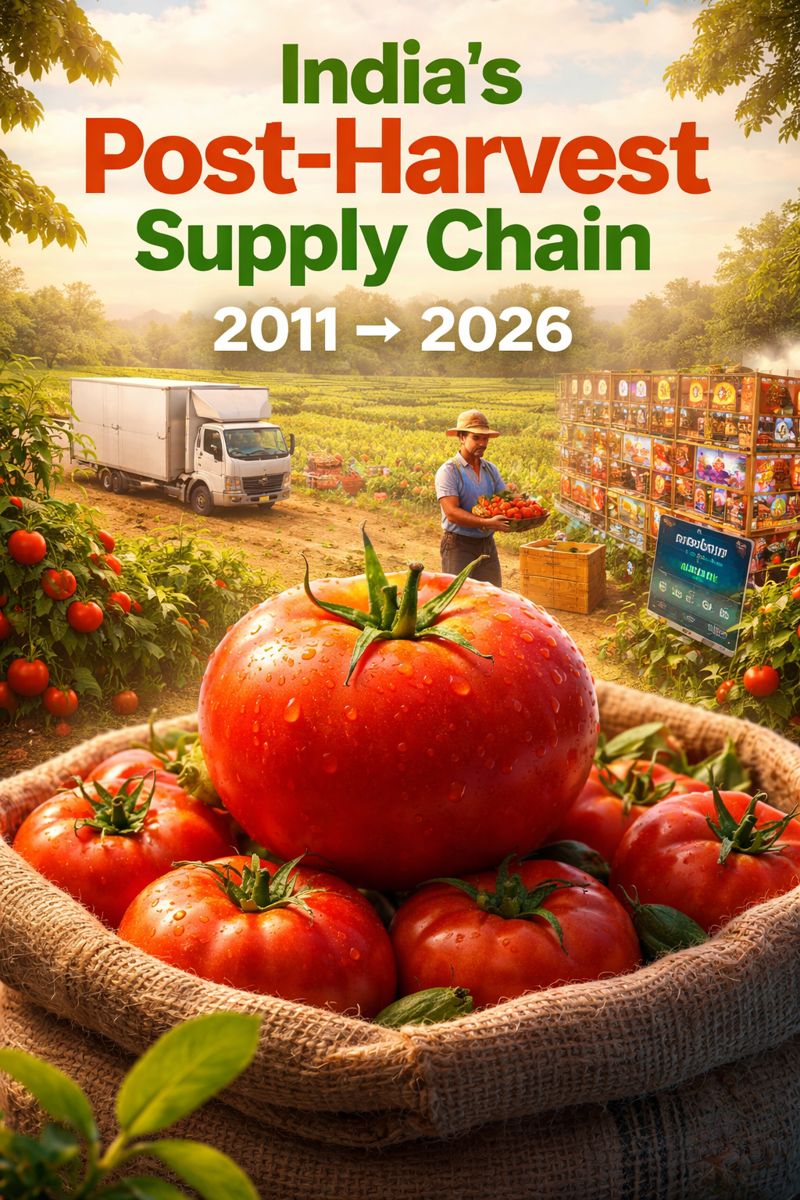
In April 2011, I wrote a tiny post that was basically a finger jab at a wound: “read this story,” then a quote about how India’s price signals die on the way back to the farm. The original is still here: What’s wrong with our post-harvest agricultural supply chain?
The quote was lifted from an Economic Times editorial titled “The PM gets it right” (Feb 15, 2011). Its diagnosis was simple and brutal: we modernised inputs, not marketing. We built an “inefficient chain” between farmer and consumer, so when retail prices spike, the farmer often sees none of the upside.
Fifteen years later, I want to rewrite that post with a real spine. Same thesis, sharper tools, newer facts, and one stubborn protagonist.
A tomato.
A tomato leaves the farm
Picture this as an illustrative journey, not a specific news report.
A farmer harvests tomatoes at dawn. By afternoon, the tomatoes have become a logistics problem wearing a red costume.
They need sorting and grading. They need crates that do not crush. They need shade. They need pre-cooling. They need transport that does not turn every bump into bruising. They need a buyer whose “price” does not change like mood.
If any link in that chain is weak, the farmer does the only rational thing available under pressure.
Sell fast. Sell cheap. Move on.
Later the same week, the city consumer complains about expensive tomatoes. The farmer hears that complaint like a rumour from another planet.
That gap is the black box.
Back in 2011, I quoted this line (still painfully accurate): the linkage between the farmer and the consumer is inefficient, wasteful, and subject to manipulation, so shortages trigger hoarding and price spikes at the consumer end without sending those higher prices back to the farmer. When price signals do not reach the farm, incentives die.
So what changed between 2011 and 2026?
Enough to matter. Not enough to relax.
2011 said “fix marketing.” 2026 says “fix time.”
Tomatoes are not merely bought and sold. They are raced.
A post-harvest system is basically a machine for buying time. Cold chain buys time. Warehousing buys time. Credit buys time. Transparent markets buy time by reducing predatory uncertainty.
India’s big story since 2011 is that we started building and financing “time.”
Change 1: We started paying for the boring parts
The Agriculture Infrastructure Fund (AIF) is a government financing facility launched in 2020–21 to support post-harvest and farm-gate infrastructure through interest subvention and credit guarantee support.
As of June 30, 2025, the Press Information Bureau (PIB) reported ₹66,310 crore sanctioned under AIF for 1,13,419 projects, mobilising ₹1,07,502 crore of investment, including 2,454 cold storage projects.
This is not a philosophical change. It is a cash-flow change. And supply chains love cash-flow.
Change 2: Cold chain scaled, and policy got more specific
The Ministry of Food Processing Industries (MoFPI) runs the Integrated Cold Chain and Value Addition Infrastructure (ICCVAI) scheme under the Pradhan Mantri Kisan Sampada Yojana (PMKSY).
As of June 2025, 395 integrated cold chain projects had been approved since 2008, with 291 operational, creating preservation capacity of 25.52 lakh metric tonnes (LMT) per year and processing capacity of 114.66 LMT per year.
MoFPI also notes a key policy shift in June 2022: support for fruit and vegetable cold chain projects under that scheme component was discontinued and the sector was shifted to Operation Greens.
In plain terms: the government stopped pretending every crop has the same bottlenecks.
For our tomato, this matters. Not because cold chain is glamorous, but because it turns “sell today or lose everything” into “sell when the price is sane.”
Change 3: Markets became more digital, and more visible
The electronic National Agriculture Market (e-NAM) integrates regulated wholesale markets (mandis) into an online trading platform.
PIB reported that 1,522 mandis were integrated as of June 30, 2025, with 1,79,41,613 farmers and 4,518 Farmer Producer Organisations (FPOs) registered, and total traded value of ₹4,39,941 crore recorded on the platform.
If 2011 was about “price signals,” e-NAM is one attempt to strengthen the signal.
But an honest note: a stronger signal does not automatically fix the physical chain. A dashboard cannot refrigerate a tomato.
Change 4: Farmer collectivisation moved from slogan to infrastructure
A Farmer Producer Organisation (FPO) is a farmer collective that can aggregate produce, negotiate, and invest in shared capabilities.
The “Formation and Promotion of 10,000 FPOs” scheme hit the 10,000 milestone by Feb 2025, according to PIB. The same release describes equity grants and credit guarantee cover supporting thousands of FPOs.
This is quietly revolutionary. A single farmer is forced to accept the chain. A collective can start owning pieces of it.
A tomato handled by an FPO can be graded, packed, stored, and sold with leverage. The same tomato, different fate.
Change 5: Storage plus credit got sharper
In 2011, the farmer’s big enemy was forced timing. In 2026, the fight is increasingly about making “waiting” financially possible.
The Warehousing Development and Regulatory Authority (WDRA) oversees warehousing regulation and electronic warehouse receipt systems. A Parliamentary Standing Committee report notes the growth of pledge finance against electronic Negotiable Warehouse Receipts (eNWRs).
The same report notes the launch on 04-03-2024 of e-Kisan Upaj Nidhi, a digital gateway developed by WDRA in association with NABARD (National Bank for Agriculture and Rural Development) and a task force in SBI (State Bank of India), to connect eNWR with onboarded banks.
This is the most direct antidote to the 2011 problem. If you can store and borrow, you are not forced to sell at the worst possible moment.
The uncomfortable part: loss is still huge
Even with better financing, more cold chain, more digital markets, and stronger farmer collectives, the scale of loss remains enormous.
A 2024 policy brief by the Indian Council for Research on International Economic Relations (ICRIER) cites a NABARD Consultancy Services (NABCONS) 2020–2022 study estimating food loss in India at about ₹1.53 trillion (USD 18.5 billion) annually due to post-harvest losses (PHL). The brief also argues that reducing PHL is often more cost-effective than producing more and losing more.
So yes, we built scaffolding. But we are still leaking value at industrial scale.
So what is the 2026 thesis, using the tomato as proof?
The 2011 editorial said policy must recognise marketing’s role in boosting farm production. I agree, but I want to update the framing.
India’s post-harvest problem is a systems problem where incentives and physics collaborate to bully the weakest player.
Tomatoes punish delay. Markets punish small scale. Credit punishes the poor. Information punishes the disconnected.
Since 2011, India has improved the tools that buy time and improve bargaining power: financing (AIF), cold chain (ICCVAI under PMKSY), digital trading (e-NAM), collectivisation (FPOs), and storage-linked credit (WDRA eNWR and e-Kisan Upaj Nidhi).
Now the real question is not “do we have schemes?”
It is “does our tomato still get forced into the panic-sale path?”
If the answer is yes, the black box still wins.
If the answer becomes no, then the farmer finally gets what the consumer already has.
Choice.
References (links)
-
Original 2011 post on SystemHalted:
https://systemhalted.in/2011/04/26/whats-wrong-with-our-post-harvest-agricultural-supply-chain/ -
Quoted editorial (2011, original link from my post):
https://economictimes.indiatimes.com/opinion/et-editorial/the-pm-gets-it-right/articleshow/7499198.cms -
PIB note on Agriculture Infrastructure Fund (AIF) status (as of 30 June 2025):
https://www.pib.gov.in/PressNoteDetails.aspx?ModuleId=3&NoteId=154999 -
PIB release on e-NAM registrations and traded value (as of 30 June 2025):
https://www.pib.gov.in/PressReleasePage.aspx?PRID=2151361 -
PIB release on the 10,000 Farmer Producer Organisations (FPOs) milestone (Feb 28, 2025):
https://pib.gov.in/PressReleasePage.aspx?PRID=2106913 -
Integrated Cold Chain and Value Addition Infrastructure (ICCVAI) status note (PDF; includes June 2025 stats):
https://static.pib.gov.in/WriteReadData/specificdocs/documents/2025/oct/doc20251029679501.pdf -
Parliamentary Standing Committee report (PDF; mentions eNWR pledge finance and e-Kisan Upaj Nidhi launch):
https://sansad.in/getFile/lsscommittee/Consumer%20Affairs%2C%20Food%20and%20Public%20Distribution/18_Consumer_Affairs_Food_and_Public_Distribution_2.pdf?source=loksabhadocs -
ICRIER Policy Brief 20 (PDF) summarising the NABCONS 2020–2022 loss estimate:
https://icrier.org/pdf/Policy_Brief_20.pdf -
WDRA page describing e-Kisan Upaj Nidhi:
https://wdra.gov.in/web/wdra/e-kisan-upaj-nidhi
Notes
Abbreviations introduced in this post
- AIF: Agriculture Infrastructure Fund
- PIB: Press Information Bureau
- MoFPI: Ministry of Food Processing Industries
- PMKSY: Pradhan Mantri Kisan Sampada Yojana
- ICCVAI: Integrated Cold Chain and Value Addition Infrastructure
- LMT: lakh metric tonnes
- e-NAM: electronic National Agriculture Market
- Mandi: regulated wholesale agricultural market
- FPO: Farmer Producer Organisation
- WDRA: Warehousing Development and Regulatory Authority
- eNWR: electronic Negotiable Warehouse Receipt
- NABARD: National Bank for Agriculture and Rural Development
- SBI: State Bank of India
- NABCONS: NABARD Consultancy Services
- ICRIER: Indian Council for Research on International Economic Relations
- PHL: post-harvest losses
About the tomato story
The tomato journey section is a simplified narrative device to make the supply chain concrete. It is not a claim about one specific farmer or one specific price spike.