Stereotypes Are Lazy Maps
10 Jan 2026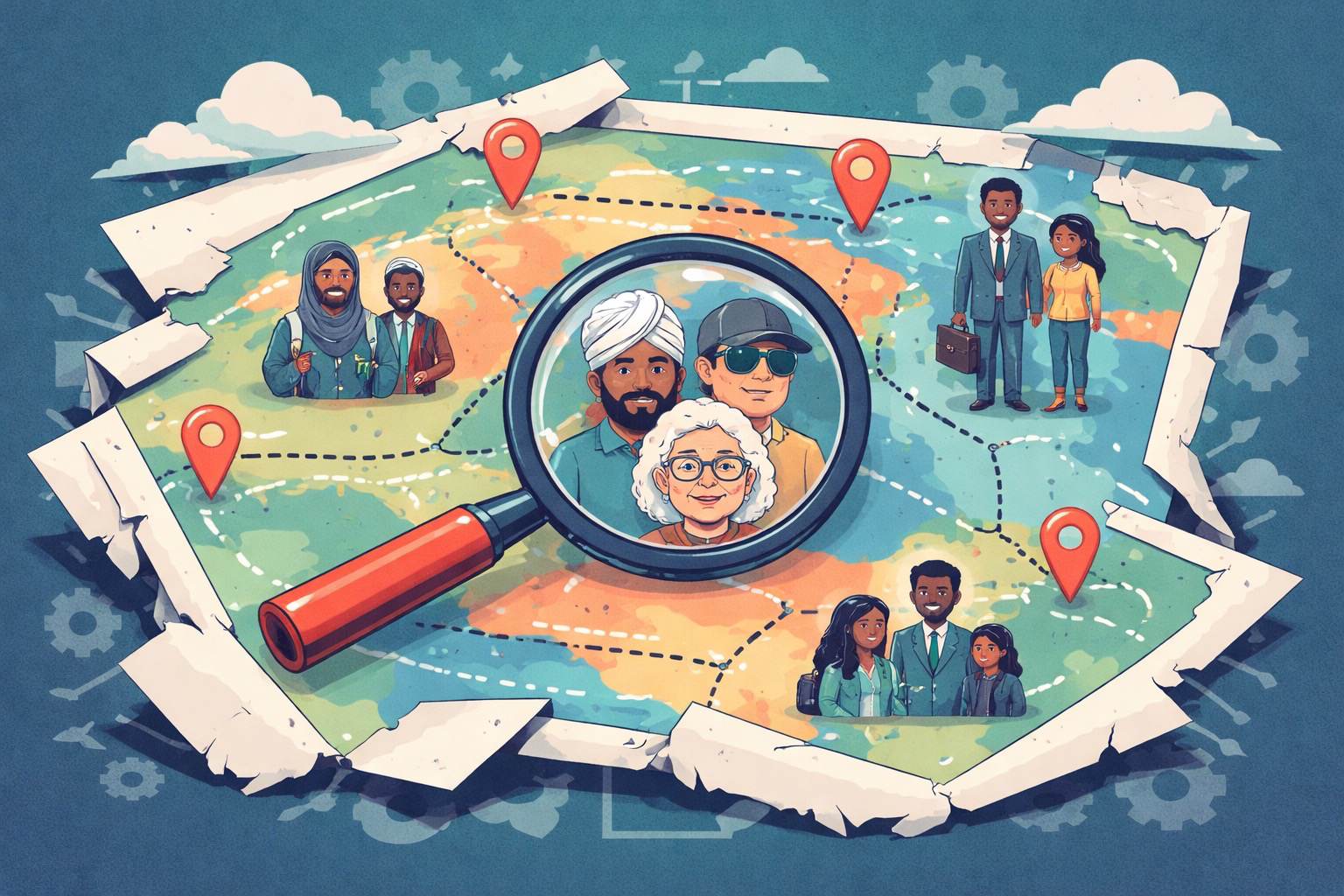
A stereotype is a shortcut.
A generalization is a guess.
And both are dangerously tempting when you’re tired, annoyed, or trying to compress the human universe into a single sentence.
But a shortcut is not the same thing as the truth.
This post started the way many modern thoughts begin: with a social media thread.
I saw a post about “student drivers” which soon turned into a generalization about an entire people. Someone responded by generalizing Indians in one long breath, without the courtesy of a comma, a semicolon, or a full stop.
The irony wasn’t subtle. The emotional whiplash wasn’t either.
This isn’t only about Indians. Or Americans. Or any one group. It’s about a habit of mind we’ve normalized: reducing millions of people into a neat sentence and calling it “an observation.”
The world is too large for our brains
Human brains are pattern machines. We find faces in clouds. We infer intent from a raised eyebrow. We build models of reality because raw reality is too big to hold.
That instinct isn’t evil. It’s survival.
The problem begins when we confuse the model for the world.
A stereotype is what happens when you take a small sample, add emotion, toss in a few viral anecdotes, and then export it as a universal law.
It feels efficient. It feels satisfying. It feels like closure.
It’s also how we end up misreading entire peoples.
“Indians are…” is a sentence that breaks under its own weight
India isn’t a monolith. It’s a continent-sized civilization, with many languages, many histories, many moral philosophies, many economic realities, and many ways of being human.
So when someone says “Indians are X,” what they’re often saying is something closer to:
“I met some Indians.”
“I saw a few videos.”
“I had one bad experience.”
“I read a thread that made me feel righteous.”
And then the brain does its favorite magic trick: it turns an anecdote into an identity.
That’s not insight. That’s laziness with confidence.
The equal and opposite mistake
Here’s the twist: the antidote to “Indians are…” is not “Americans are…”
The United States is the third-largest country in the world by population. It contains multitudes: regions that feel like different planets, communities built from different migrations, value systems that clash, and identities that don’t fit into clean boxes.
So yes, broad generalizations about Americans are unfair.
But this is exactly how conversations collapse into noise: people respond to one stereotype by throwing another stereotype back like a dodgeball.
The result isn’t justice. It’s just more laziness, moving faster.
The “small loud group” problem
A common defense goes like this:
“I’m not generalizing everyone. I’m talking about a certain kind of person.”
Sometimes that’s true. Social media amplifies extremes. Outrage is algorithmic fuel. The loudest voices get the mic even when they represent very little.
But adult conversation requires adult precision.
There’s a big difference between:
- “Some people are doing this harmful thing.”
- “This group is like this.”
The first is a claim about behavior. It can be debated, measured, challenged, and refined.
The second is a claim about identity. It essentializes. It turns a behavior into a blood type.
That’s the line. That’s the whole game.
Why stereotypes feel so good
Stereotypes offer three things the internet loves:
Certainty: “I understand what’s going on.”
Speed: “I don’t need to do the work.”
Permission: “Now I can judge.”
Real understanding is slower. It requires friction. It requires the irritating humility of saying, “I might be wrong,” and then gathering better evidence like a grown-up scientist.
This is what philosophers call epistemic humility1. It is the recognition that our knowledge is always incomplete, our samples always limited, our certainty always provisional.
It’s the opposite of what social media rewards.
That’s harder than typing a hot take.
A better way to speak
If you want to criticize a pattern without flattening people into cardboard cutouts, here are healthier defaults:
- Speak about specific behaviors, not identities.
- Use “some” and “in my experience” like seatbelts.
- Separate “what I saw” from “what is true.”
- Ask whether your sample is representative or just memorable.
- When you feel righteous, pause. Righteousness is not a fact-checker.
If your goal is to be understood, precision is kindness.
Immigrants live inside the blur
Immigrants often occupy a strange space. You learn to love the country you live in while also carrying the ache of being misread. You become bilingual not just in language, but in assumptions.
Sometimes you’re treated as an ambassador for a billion people.
Sometimes you’re treated as an exception: “You’re not like the others.”
Sometimes you’re reduced to a meme.
And through it all, you still show up. You contribute. You build. You teach. You try to belong without having to dissolve.
So when someone stereotypes a group, it isn’t “just words.”
It’s a tiny social verdict that sticks.
The point
Even saying “everyone stereotypes” would be unfair (which is, awkwardly, the entire point of this post).
After that thread, I also received kind messages from people in my local community offering support and apologizing “on behalf of” others. The intent was generous, and I appreciated it.
But even there, I felt the shadow of the same mistake: the idea that there is a “them” to speak for.
There shouldn’t be.
We don’t defeat stereotypes by pretending differences don’t exist. We defeat stereotypes by being honest about complexity.
By trading lazy certainty for careful clarity.
By resisting the cheap thrill of the sweeping sentence.
By remembering that every “they” is made of millions of “someone.”
The world is weird and diverse and stubbornly detailed.
That’s not a problem to solve.
That’s the whole miracle.
References and Notes
-
Epistemic humility: https://en.wikipedia.org/wiki/Epistemic_humility ↩