Semantic Networks as Search Spaces
A semantic network is a graph-based system to represent knowledge. It is a mind-map, that uses nodes to represent concepts and edges to define the relationship.
A semantic network is useful because it forces you to say what the world contains and how one state can become another.
That sounds simple, but it is the hard part of many AI problems. Before an agent can search, reason, or explain a path, it needs a representation of the situation. The representation does not need to contain everything. In fact, a good representation usually leaves out most things. It needs to contain the distinctions that matter for the task.
Once those distinctions are explicit, the problem starts to look like a graph.
Nodes are states. Edges are transformations. A path through the network becomes a candidate solution. The agent's job is no longer to “think” in some vague sense. Its job is to move through the represented space in a disciplined way.
Generate and test
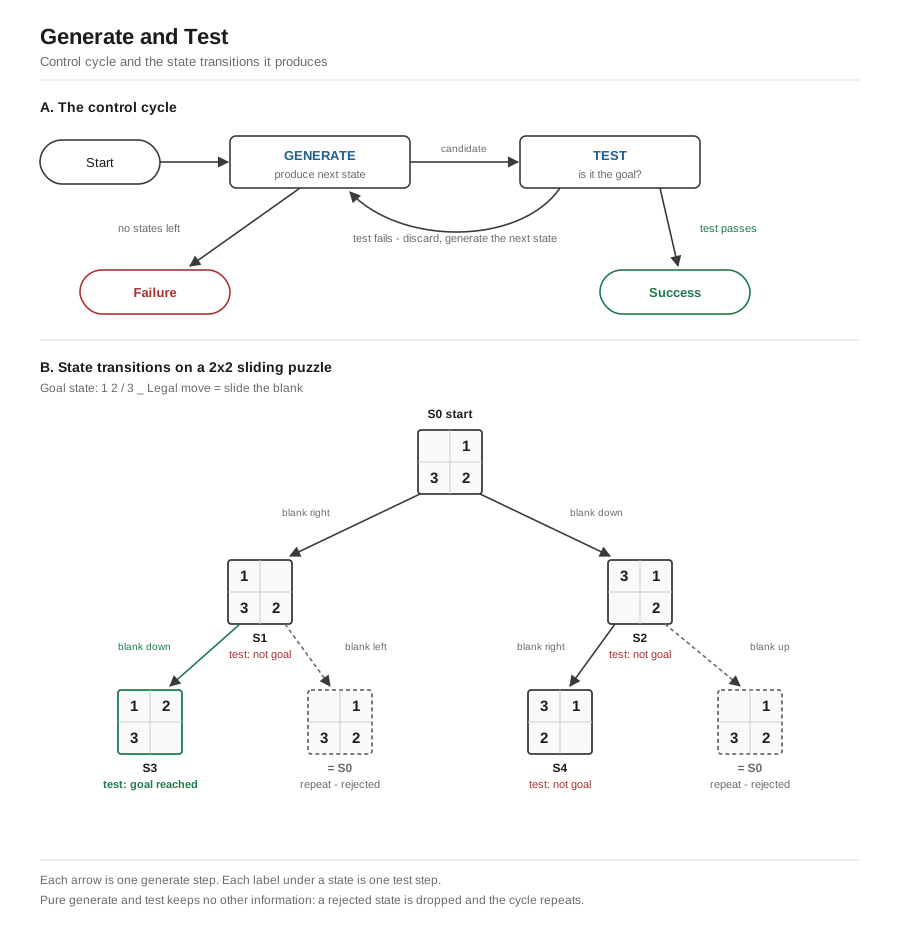
The generate-and-test pattern is one of the simplest ways to use that structure.
The generator proposes a possible next state. The tester checks whether that state is legal, useful, or final. If the state does not work, the system generates another candidate. If it does work, the system keeps it and continues.
That pattern is easy to underestimate because it sounds brute-force. But the important design question is not only how candidates are generated. It is what the system remembers.
If the agent does not remember prior states, it can loop. It can regenerate the same state again and again, wasting time and appearing less intelligent than it really is. In a graph, memory is not a luxury. It is part of the search machinery.
So the generator has at least two responsibilities:
- Produce plausible next states.
- Avoid returning to states the system has already explored.
The tester also has at least two responsibilities:
- Reject invalid transitions.
- Recognize when the current state satisfies the goal.
Once those responsibilities are separated, the AI problem becomes easier to reason about. You can improve the generator without changing the tester. You can make the tester stricter without rewriting the whole search.
Why representation matters
The value of a semantic network is not the diagram itself. The value is the discipline it imposes.
It asks:
- What counts as a state?
- What relations connect states?
- Which transformations are legal?
- Which state is initial?
- Which state is final?
- What must be remembered to avoid cycling?
These questions show up everywhere in software, not just in AI courses. Workflow engines, build systems, dependency graphs, compilers, routers, game engines, and planning tools all depend on some version of this idea. A system behaves better when its state space is made explicit.
The practical lesson
Many AI discussions jump too quickly to model capability. But for knowledge-based AI, the representation often matters more than the algorithm.
A weak representation makes even a clever search look confused. A strong representation can make a simple generate-and-test loop surprisingly effective.
So a lot of the work in a knowledge-based system happens before the search runs at all. It happens when you decide what the agent is allowed to see.