Is an Anthill Conscious?
The brain and the anthill make an unsettling comparison because both seem to do more than their parts may explain on their own.
A neuron does not think. An ant does not plan the long-term fate of a colony. But a brain produces cognition through the interaction of neurons, and an ant colony produces coordinated behavior through the interaction of ants. In both cases, the interesting property lives at the level of the system, not the individual unit.
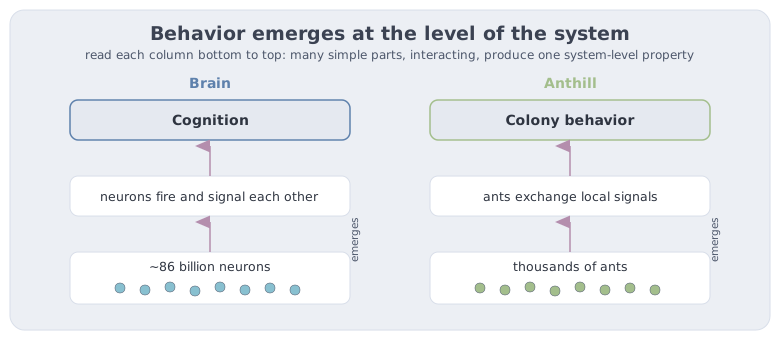
That does not prove that an anthill is conscious. It does, however, make the question harder to dismiss.
The analogy
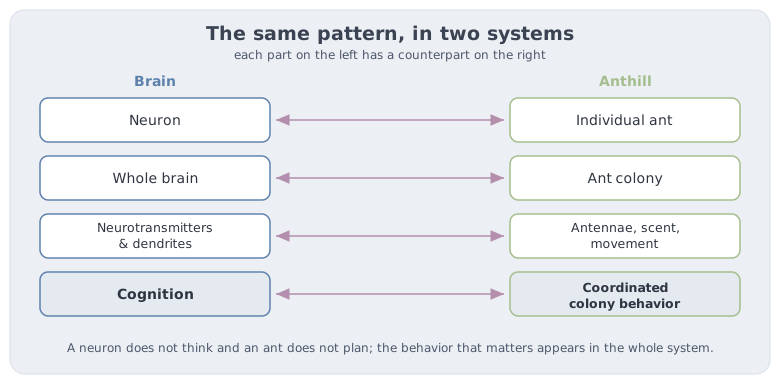
At the simplest level, the mapping looks like this:
- A neuron maps to an individual ant.
- A brain maps to an ant colony.
- Neurotransmitters and dendrites map, roughly, to the signals ants exchange through antennae, movement, scent, and local interaction.
- Cognition maps to the organized behavior that emerges from many small interactions.
The analogy is not perfect. A brain and a colony are built differently, operate at different speeds, and solve different classes of problems. But the analogy is useful because it forces a discipline on the question. If we are willing to talk about cognition as something that emerges from many non-conscious parts in the brain, we should at least ask what kind of intelligence emerges from many simple agents in a colony.
A Vedantic test
In an earlier post I used the six pramanas from Advaita Vedanta as a way to think about intelligence and artificial intelligence. They are not a laboratory test in the modern scientific sense. They are a philosophical framework for asking how knowledge is acquired and justified.
Applied to an anthill, they give us a useful checklist.
Pratyaksha, or perception:
The colony can sense its surroundings through the distributed activity of individual ants. No single ant perceives the whole environment, but the colony can still respond to food, threat, nest quality, temperature, and other conditions.
Anumana, or inference:
The colony can turn local signals into collective decisions. A change in behavior follows from accumulated evidence, even if no individual ant is performing explicit reasoning in the human sense.
Upamana, or comparison and analogy:
Colonies can compare alternatives. Nest selection is a good example: scouts evaluate candidate sites, and the colony eventually converges on one option over another.
Arthapatti, or postulation:
The colony can behave as if it is evaluating implications. If one nest site has better darkness but a worse entrance, and another has the reverse, the colony's final movement reflects a tradeoff across conditions.
Anupalabdhi, or non-perception:
The colony can incorporate absence. If a path stops producing food or a site fails to attract enough confirming activity, the colony's behavior changes. This is not a formal proof of non-existence, but it is a practical response to missing evidence.
Shabda, or word/testimony:
A colony has memory beyond the life of an individual ant. Its trails, nest structure, and learned patterns can persist across generations. In that sense, the colony can rely on information that no single living ant originated alone.
Under this framework, an anthill does surprisingly well.
But is that consciousness?
The checklist shows that an anthill can satisfy several conditions we associate with intelligence: perception, inference, comparison, tradeoff, response to absence, and retained knowledge. That makes the anthill a strong example of collective intelligence.
But consciousness is a heavier claim than intelligence.
A system can process information without having inner experience. A market can aggregate signals. A city can route traffic. A software organization can remember habits that no employee wrote down (tribal knowledge). These systems can be intelligent in a distributed sense without obviously having a point of view.
An anthill behaves like a system with distributed cognition. It acquires information, compares alternatives, responds to missing signals, and preserves useful patterns across time. If consciousness is defined only in terms of knowledge acquisition and coordinated response, then the colony begins to qualify. If consciousness requires subjective experience, then the analogy becomes suggestive but not decisive.
Why this matters for AI
Modern AI systems are increasingly built as networks of smaller processes: models, tools, prompts, retrieval systems, evaluators, schedulers, memory stores, human feedback, and organizational review. Like an anthill, the behavior of the system is not located cleanly in any single part.
Once a distributed system begins producing impressive behavior, people start reaching for words like intelligence, agency, and consciousness. Sometimes those words clarify. Often they hide the real engineering question.
Asking whether the system feels conscious is not very useful, because we do not know how to answer it well. It is more practical to ask what the system actually does:
- What does the system perceive?
- What can it infer?
- What alternatives can it compare?
- What tradeoffs can it evaluate?
- What absences can it detect?
- What past knowledge does it rely on?
Those questions are practical. They can be tested. They also keep us from giving a system metaphysical credit[1] for behavior that may be explainable through coordination, feedback, and memory.
Complex behavior does not require a tiny human sitting inside the system, making central decisions. Intelligence can emerge from interaction. But the existence of emergence does not automatically settle the question of consciousness, and it is worth keeping those two questions apart.
References
Bob Holmes, “The Mind of an Anthill”, Knowable Magazine, 2018.
Deborah M. Gordon, “Your brain has more in common with an ant colony than you realised”, World Economic Forum, 2019.
Eliot Deutsch and Rohit Dalvi, The Essential Vedanta: A New Source Book of Advaita Vedanta, 2004.
Notes
[1] In this context, “metaphysical credit” means attributing consciousness or subjective experience to a system just because it produces impressive behavior. It's the leap from “this system does something smart” to “this system must be aware of what it's doing.” My point in this post is that complex coordinated behavior, such as an anthill solving problems, an AI generating text, etc. can be fully explained by local interactions, feedback, and memory without invoking inner experience. Giving the system “metaphysical credit” is treating emergence as evidence of consciousness, when it might just be coordination.
